Jul 22, 2026
SSPM vs CASB for Shadow SaaS and AI in 2026


Compare SSPM vs CASB for Shadow SaaS and AI, including discovery, identity, OAuth, posture, and governance.

Jul 22, 2026
Compare SSPM vs CASB for Shadow SaaS and AI, including discovery, identity, OAuth, posture, and governance.
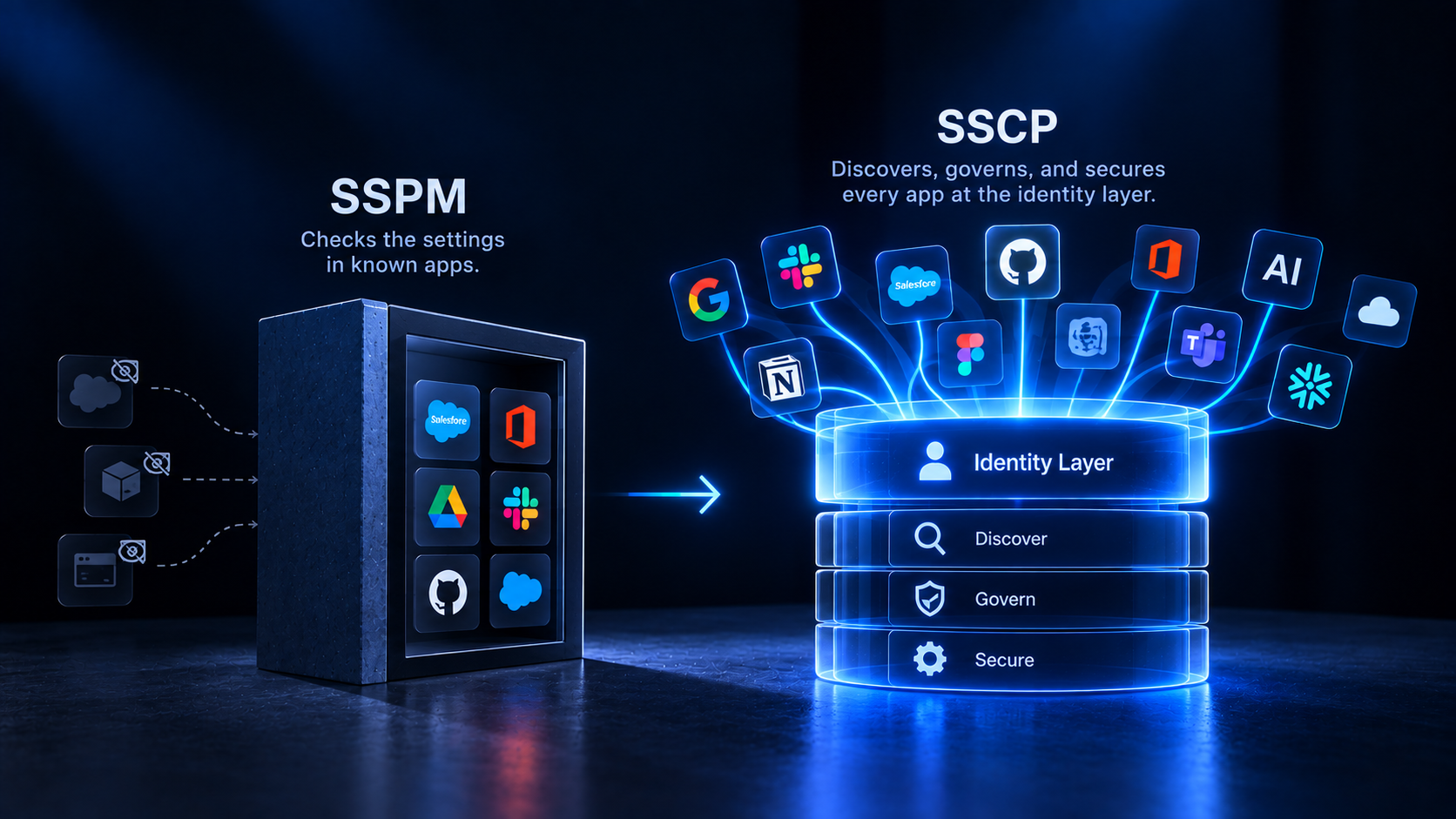
CASB and SSPM address different parts of SaaS security. A cloud access security broker (CASB) primarily helps organizations govern access to cloud services, enforce policies, protect data, and identify sanctioned and unsanctioned application usage. SaaS security posture management (SSPM) focuses on continuously assessing SaaS configurations, security posture, permissions, and other risks within SaaS applications.
For Shadow SaaS, CASB can provide valuable application and activity visibility, while SSPM can provide deeper context into the security posture of connected applications. Shadow AI complicates the comparison because AI increasingly operates inside approved SaaS applications and through OAuth connections, AI agents, non-human identities, and SaaS-to-SaaS integrations.
As a result, securing modern SaaS and AI environments increasingly requires capabilities that extend beyond the traditional scope of either category alone.
A cloud access security broker (CASB) is a security technology that provides visibility and policy enforcement between users and cloud services.
CASBs traditionally help security teams understand which cloud applications employees access, distinguish between sanctioned and unsanctioned services, enforce security policies, and protect sensitive data moving through cloud environments.
Common CASB capabilities include:
These capabilities remain valuable, particularly for organizations that need to understand cloud application usage and enforce controls around how users access those services.
The challenge is that discovering an application does not necessarily explain its full security posture or the identities, integrations, permissions, and AI capabilities operating within it.
SaaS security posture management (SSPM) continuously identifies and helps remediate security risks within SaaS applications.
Where CASB traditionally focuses heavily on access to cloud services, SSPM looks more deeply at the security posture of the SaaS environment itself.
SSPM commonly evaluates areas such as:
The emphasis on continuous monitoring is important because SaaS environments change constantly. Administrators modify settings, users grant permissions, integrations are added, and vendors release new functionality.
SSPM can therefore help answer an important question after an application has been discovered: What security risks exist inside this SaaS environment right now?
Shadow SaaS refers to SaaS applications adopted or used without complete security or IT oversight.
CASB has historically played an important role in identifying this activity. By observing cloud access and application usage, a CASB can help security teams identify unsanctioned services and enforce policies around them.
SSPM approaches the problem differently. Once SaaS applications are known or connected, SSPM can continuously assess their security posture and identify configuration and governance risks.
Neither perspective tells the entire story by itself.
For traditional Shadow SaaS, CASB may offer strong visibility into which applications users access. SSPM can complement that visibility by evaluating the security posture of SaaS applications.
In 2026, however, the distinction becomes more complicated because the shadow environment increasingly includes AI.
Shadow AI is frequently treated as a discovery problem: find the AI applications employees are using.
That is only one part of the risk.
Grip's 2026 Mid-Year AI Exposure Update found that 54% of enterprise applications contain detectable AI functionality. The average Grip customer also uses 1,017 AI-enabled applications.
These are 2026 observations, and they illustrate an important shift. AI is no longer confined to standalone tools that can simply be classified as sanctioned or unsanctioned.
AI can appear through:
Consider an approved SaaS platform that introduces an AI assistant.
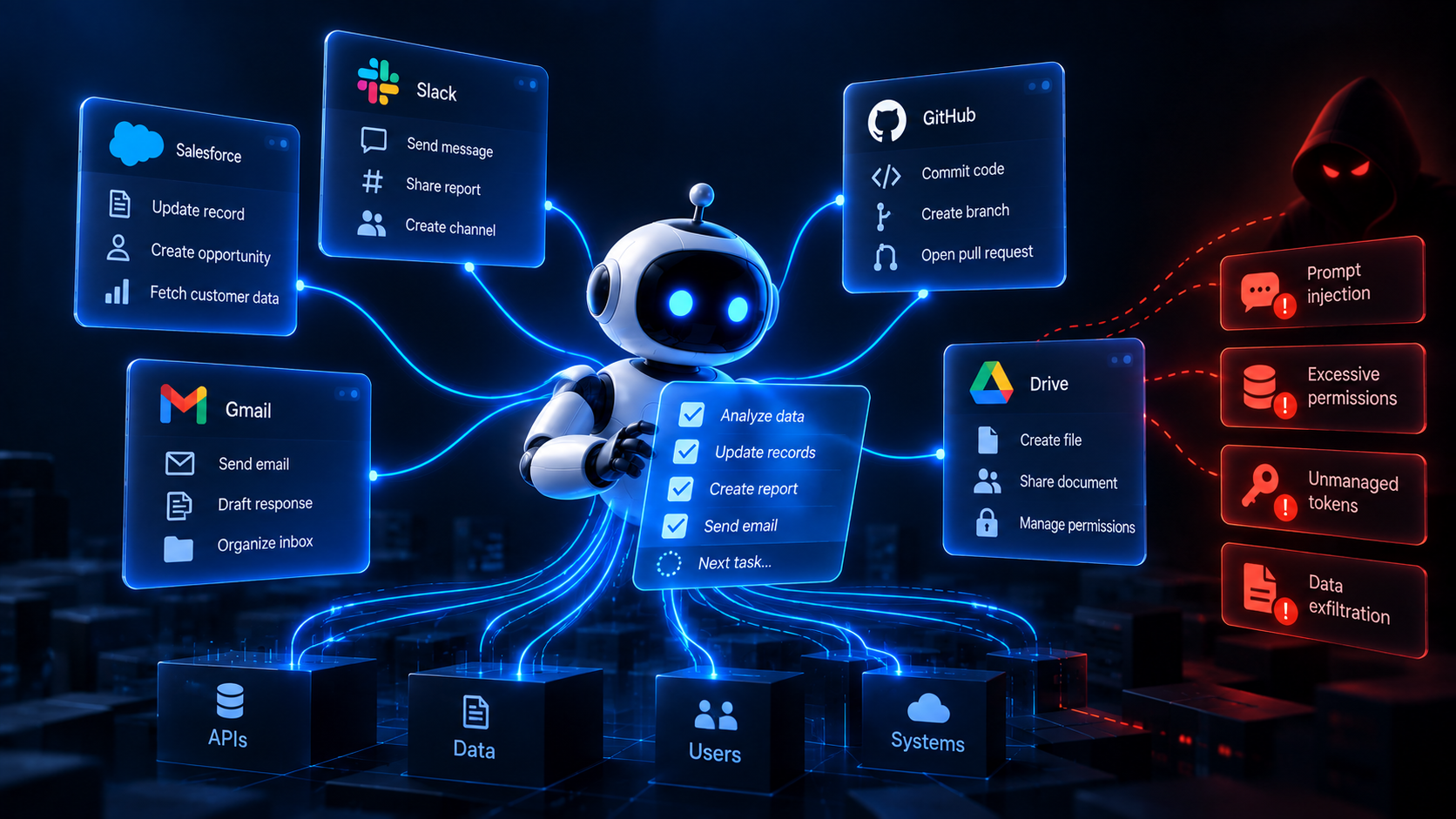
The application itself may remain sanctioned. But the AI functionality could gain access to enterprise data, interact with connected applications, inherit user permissions, or create new machine-to-machine relationships.
An application inventory alone may show nothing unusual.
This is why Shadow AI changes the CASB vs SSPM discussion. Security teams increasingly need to understand not only which application is being used, but also what AI functionality exists, which identities can use it, what permissions it holds, what data it can reach, and what other systems it can interact with.
Shadow SaaS has evolved into an identity and access problem as much as an application discovery problem.
Applications provide one layer of SaaS visibility. Identity provides the context required to understand who or what can actually act through them.
Modern SaaS environments contain both human identities and growing populations of non-human identities (NHIs), including service accounts, API-driven identities, integrations, automation, and AI agents.
Grip's 2026 Mid-Year AI Exposure Update identified approximately one AI agent for every 17 identities, a relationship Grip refers to as the Rule of 17.
These identities can also persist through OAuth grants and tokens.
A user may authorize an application once, but that authorization can establish continuing access to SaaS data. Depending on the granted scopes and application behavior, the resulting connection may continue operating without the user actively interacting with it.
That means SaaS and AI risk increasingly depends on questions such as:
This identity context helps transform SaaS discovery into risk understanding.
The emerging model is straightforward:
AI Risk → Identity → Governance → Continuous Control
Discovering an application or AI capability is valuable. Understanding the identities and permissions behind it makes that discovery actionable.
The right CASB vs SSPM decision depends on an organization's architecture, existing security stack, and specific risks. Some enterprises will continue to use both categories because they address complementary requirements.
Rather than evaluating products exclusively by category labels, security leaders should examine whether their overall SaaS security architecture can provide the following capabilities.
Can the organization continuously identify SaaS usage, including applications outside the approved technology portfolio?
Can security teams identify standalone AI services as well as AI functionality embedded inside existing SaaS applications?
Can the platform continuously detect risky SaaS settings, configuration drift, and posture changes?
Can security teams connect SaaS and AI activity with the human and non-human identities responsible for it?
Can teams understand connected applications, OAuth grants, permission scopes, persistent access, and potentially excessive permissions?
Can the organization identify machine identities and AI agents that may interact with SaaS applications and enterprise data?
Can security teams distinguish between simple application presence and meaningful exposure based on permissions, identity, configuration, integrations, and data access?
Can security policies be consistently applied across SaaS applications, AI functionality, identities, and integrations?
Can identified risks lead to practical remediation rather than accumulating as another stream of security findings?
These criteria shift the evaluation from "Do we need CASB or SSPM?" toward a more useful question:
"Do we have continuous visibility and control across the relationships that create SaaS and AI risk?"
For Shadow SaaS, CASB and SSPM provide complementary capabilities rather than interchangeable solutions.
CASB can provide valuable visibility into cloud application access, user activity, unsanctioned services, data movement, and policy enforcement. SSPM provides deeper visibility into SaaS configurations, posture, permissions, and continuous security risks within applications.
Shadow AI expands the challenge beyond the traditional boundaries of both categories.
AI functionality can appear inside sanctioned SaaS, operate through OAuth connections, inherit permissions, interact through AI agents and non-human identities, and connect applications that security teams previously evaluated independently.
The result is a broader security requirement: continuously understanding the relationships among applications, identities, AI functionality, permissions, integrations, configurations, and data.
This is one reason SaaS security architecture is evolving toward broader models of continuous SaaS security control. CASB and SSPM remain important parts of that conversation, while the ultimate objective is continuous visibility that leads to governance and control.
CASB primarily focuses on visibility and policy enforcement around access to cloud applications, including application discovery, user activity, and data protection. SSPM primarily focuses on continuously identifying and remediating security posture and configuration risks within SaaS applications.
Not necessarily. CASB and SSPM traditionally address different security requirements and can be complementary. Whether an organization needs one or both depends on its SaaS environment, security architecture, existing controls, and required capabilities.
CASB can help identify access to standalone or unsanctioned AI services, depending on the product and deployment. Shadow AI can also exist inside sanctioned SaaS applications, OAuth integrations, AI agents, and non-human identities. Securing it therefore requires visibility beyond application access alone.
Enterprises should evaluate whether their SaaS security architecture provides continuous application discovery, Shadow AI visibility, SaaS configuration monitoring, identity and OAuth context, non-human identity and AI agent visibility, risk prioritization, governance, and remediation. CASB and SSPM can each contribute important capabilities to this broader approach.