Apr 2, 2026
What Are Non-Human Identities? Risks, Types, and Security


Learn what non-human identities are, why they outnumber users, and how to secure API keys, OAuth tokens, and service accounts across SaaS environments.

Apr 2, 2026
Learn what non-human identities are, why they outnumber users, and how to secure API keys, OAuth tokens, and service accounts across SaaS environments.
Cloud, SaaS, and microservices didn’t just change infrastructure. They changed identity.
Today, machine-to-machine activity dominates enterprise environments. Every integration, automation, and API call depends on a non-human identity operating behind the scenes. In most organizations, non-human identities already outnumber human users by a wide margin.
The problem is not visibility alone. It is control.
This guide explains what non-human identities are, why they create risk, and how to manage them before they become an attack path.
A non-human identity (NHI) is a digital identity assigned to software, applications, services, or machines that enables them to authenticate, access resources, and interact with other systems without human involvement.
Unlike human users, NHIs operate programmatically. They rely on credentials such as API keys, OAuth tokens, certificates, and service accounts to function.
These identities are foundational to modern SaaS environments. Every integration between tools, every automated workflow, and every background process depends on them.
As SaaS adoption expands, so does identity sprawl. Each new integration introduces additional machine identities, often without centralized visibility or governance. This is where risk accumulates.
For more on how SaaS environments expand beyond control, see our guide on SaaS sprawl and identity access management.
Traditional identity and access management was built for people. Non-human identities operate differently, at a scale and speed those systems were not designed to handle.
The difference is structural. Non-human identities do not follow the same rules as human users, which is where risk begins to accumulate.
API keys authenticate requests between services. For example, a marketing platform pulling data from a CRM relies on an API key to access that data.
Service accounts allow applications or systems to operate autonomously. A cloud workload accessing storage or compute resources typically uses a service account.
OAuth tokens enable delegated access between SaaS applications. For example, a productivity tool connecting to Google Workspace uses OAuth to access user data. These connections are a major risk surface. See more on OAuth risks.
Secrets, including cryptographic keys and certificates, secure communication between systems. These are often embedded in code or infrastructure, making them difficult to rotate or track.
Bots execute automated tasks such as data entry, reporting, or customer interactions. They operate with assigned permissions and often persist long after their original purpose.
Each of these identities performs legitimate work. The issue is not their existence, but their lack of governance.
NHIs create a layer of access that most organizations cannot fully see.
They are distributed across SaaS applications, embedded in integrations, and rarely governed with the same rigor as human users. Over time, permissions expand, tokens persist, and ownership becomes unclear.
In many environments, non-human identities outnumber human users by 10 to 1 or more. This imbalance creates blind spots.
Over-permissioned OAuth tokens and API keys are common. Once granted, they are rarely revisited. This leads to privilege creep, where machine identities retain access far beyond what they need.

There is also no equivalent of MFA for most NHIs. If a token or key is exposed, it can be used immediately. Attackers exploit this. Compromised integrations become entry points. From there, they move laterally across SaaS environments.
Recent breach patterns highlight this shift. See the analysis in SaaS breach trends and the Salesloft OAuth attack breakdown for how attackers leverage these connections.
Non-human identity management requires a different model. Traditional IAM cannot track or control identities that are created outside of it. Non-human identity security starts with visibility, but it must end with enforcement.
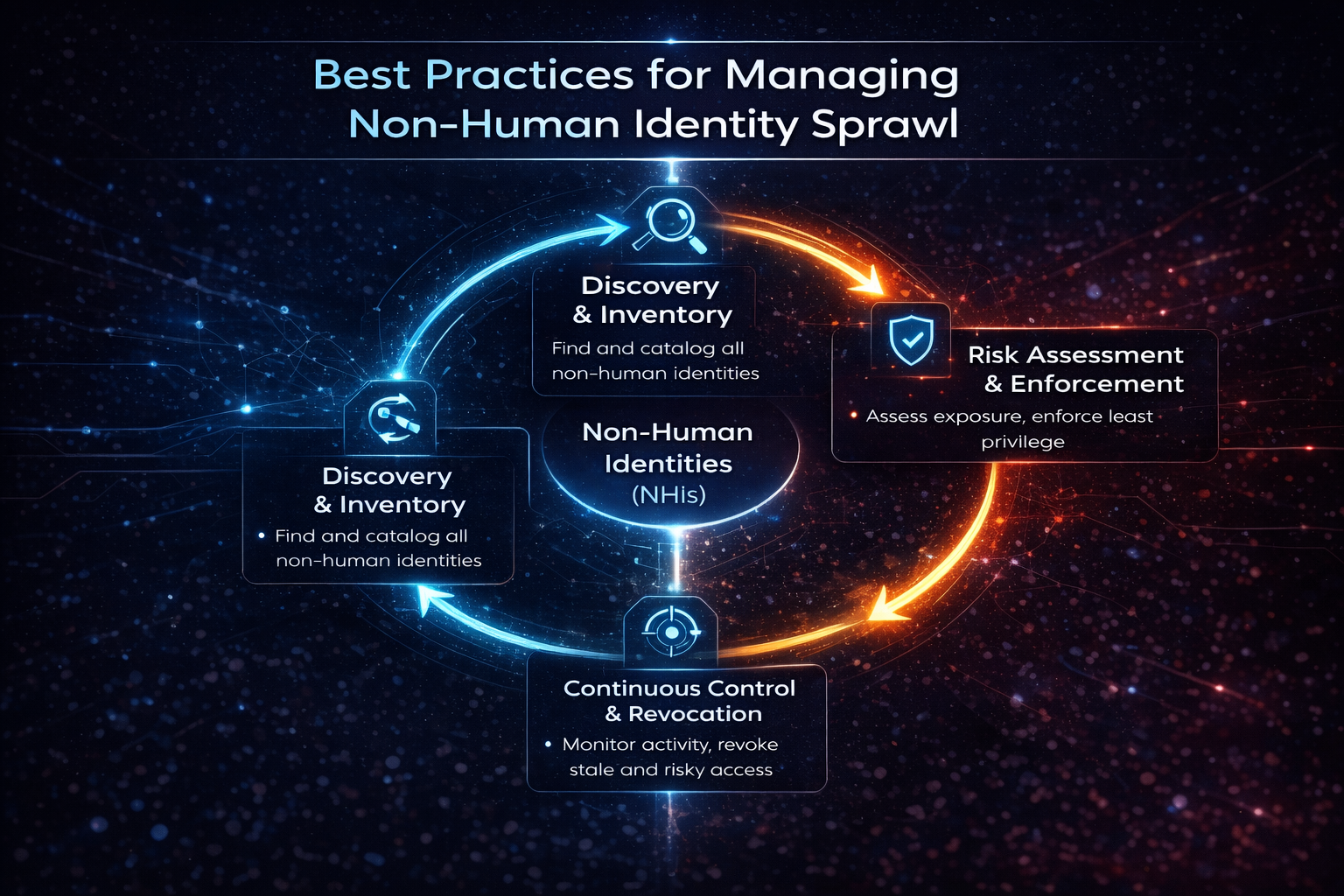
You cannot secure what you cannot see. An agentless approach continuously discovers API keys, OAuth tokens, and service accounts across the SaaS environment without relying on endpoint deployment.
Not all NHIs carry the same risk. Evaluate scope, permissions, and connected applications. Identify over-privileged tokens and integrations tied to sensitive systems or high-risk third parties.
Visibility without action is incomplete. Enforce least privilege by reducing scopes and removing unnecessary access. Revoke risky OAuth tokens and disconnect unauthorized integrations in real time.
NHIs are dynamic. Monitor behavior continuously to detect anomalies. Rotate credentials, expire inactive tokens, and remove identities that no longer serve a function.
This is the foundation of SaaS identity risk management. For broader visibility into unmanaged applications, see shadow SaaS discovery.
Non-human identities are already embedded across your SaaS environment. Most operate without visibility or control.
Grip Security identifies these connections, assesses their risk, and enforces policy across SaaS-to-SaaS interactions. This includes OAuth tokens, service accounts, and API-based access paths that traditional tools miss.
You cannot secure identities you cannot see. Grip makes them visible and actionable.
Discover how Grip Security mitigates SaaS identity risk today.
Non-human identities are created programmatically and often outside centralized IAM systems. They lack clear ownership, persist indefinitely, and rely on credentials that are rarely rotated or monitored.
Yes, the terms are often used interchangeably. Both refer to identities assigned to systems, applications, or services rather than people.
Not effectively. Traditional IAM focuses on human users and structured lifecycles. NHIs require continuous discovery, risk analysis, and enforcement across SaaS integrations, which most IAM tools were not designed to handle.