May 19, 2026
OAuth Risk Explained: The Hidden Threat in Every SaaS Connection


Learn how OAuth risk expands across SaaS and AI environments through tokens, integrations, and persistent access.

May 19, 2026
Learn how OAuth risk expands across SaaS and AI environments through tokens, integrations, and persistent access.
OAuth was designed for convenience. AI turns that convenience into scale.

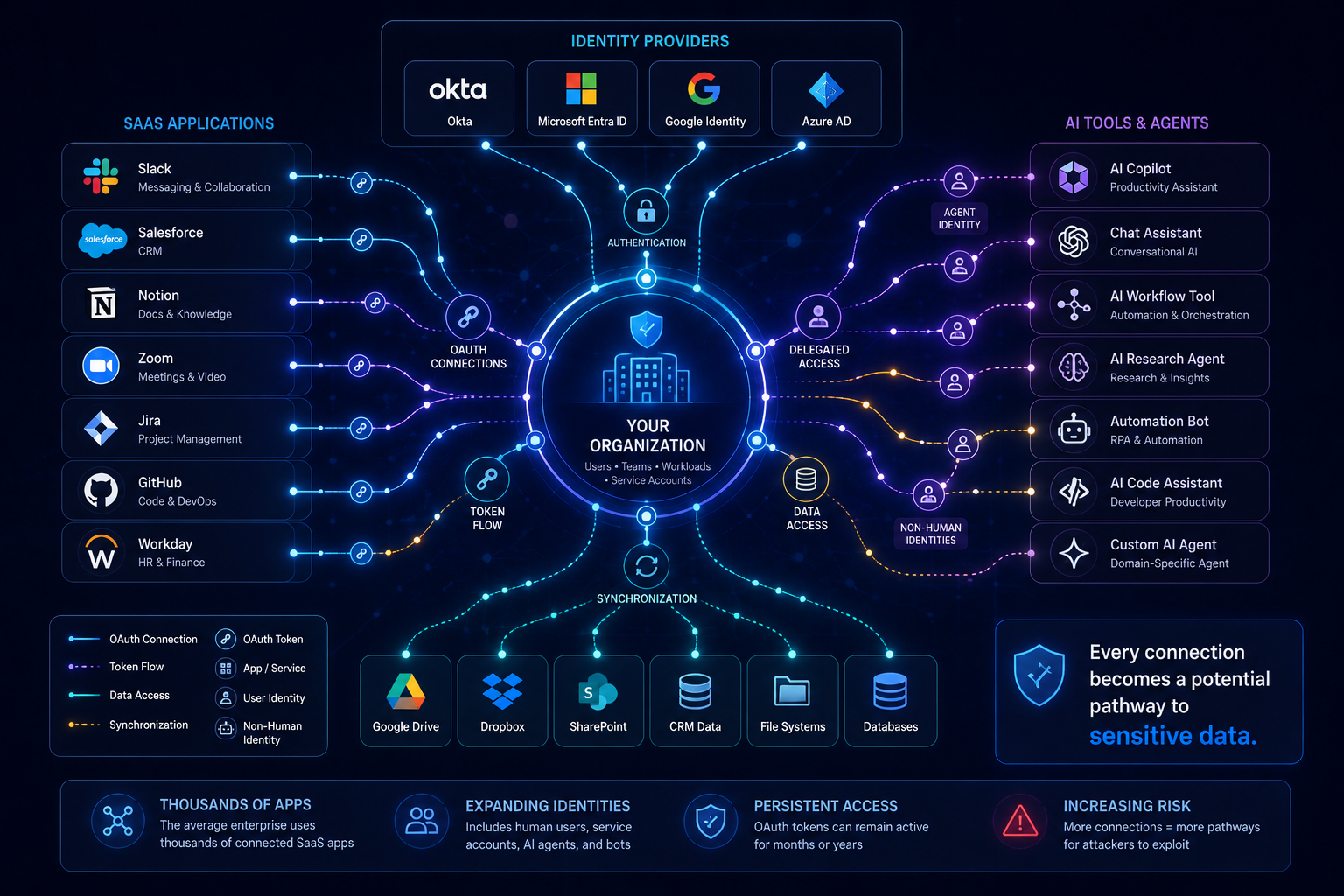
Modern SaaS environments depend on OAuth to connect applications, automate workflows, and enable AI-powered productivity. Employees connect Slack to Google Drive. AI assistants access calendars and inboxes. SaaS platforms integrate with hundreds of third-party services through APIs and delegated permissions.
Most of those connections are powered by OAuth.
The problem is that OAuth was never designed for the level of access sprawl organizations now face.
Today, the average enterprise operates thousands of SaaS and AI-connected applications, many of which rely on persistent OAuth permissions to function. At the same time, AI-related attacks have increased nearly 490% year over year, while more than 80% of SaaS and AI security incidents involve sensitive or regulated data exposure.
OAuth sits directly in the middle of this problem.
Because OAuth permissions often persist indefinitely, organizations frequently lose visibility into:
That creates a hidden layer of access risk across modern environments.
This is why OAuth risk has become one of the most important and misunderstood security challenges in SaaS and AI ecosystems.
OAuth is an authorization framework that allows one application to access resources in another application without sharing passwords.
Instead of giving an app your credentials directly, OAuth issues a token that grants limited access on your behalf.
For example:
OAuth enables these workflows through delegated permissions. These delegated access models are becoming increasingly important within modern AI governance strategies.
In simple terms:
OAuth allows applications to act on behalf of users through token-based access.

OAuth is often invisible to users because the process feels simple and fast.
Underneath that convenience is a persistent access model.
Example:
A user connects an AI meeting assistant to Google Workspace.
The application requests permissions such as:
The user signs into the identity provider:
Authentication confirms identity.
After approval, the identity provider issues an OAuth token.
The token allows the application to access specific resources without requiring the password again.
The application continues operating through the token.
In many cases:
This creates persistent access exposure.
OAuth itself is not inherently insecure.
The risk comes from how organizations use and manage OAuth at scale.
Applications frequently request broad scopes such as:
Users often approve permissions without understanding their impact.
OAuth access can remain active long after:
Dormant permissions create hidden attack surfaces.
Many security teams cannot answer:
This visibility gap grows rapidly in SaaS-heavy environments.
OAuth expands the number of active identities operating in an environment.
This includes:
Each integration becomes another operational identity layer.
Permissions often expand over time.
Applications may request:
Organizations rarely revalidate whether those permissions remain appropriate.

OAuth tokens are powerful because they reduce friction.
That same convenience creates risk.
“OAuth removes passwords from the workflow, but it does not remove access risk.”
Attackers increasingly target tokens because tokens bypass traditional login controls.
AI dramatically accelerates OAuth exposure.
Most AI tools depend on OAuth connectivity to function.
Examples include:
These systems require persistent access to:
At enterprise scale, this creates massive integration growth. This rapid expansion is one reason organizations are rethinking AI risk management in SaaS environments.
According to the 2026 SaaS + AI Security Report:
OAuth sits directly at the center of this access model.
An AI productivity tool requests:
The application only needs limited functionality, but receives broad permissions instead.
A former employee connected a third-party automation platform two years ago.
The integration still maintains:
No one realizes it still exists.
An AI assistant receives delegated permissions to:
The permissions persist continuously across workflows.
This creates:
The more AI systems organizations deploy, the faster these layers compound.
This is why OAuth risk behaves like infrastructure expansion, not just application access.

Organizations first need visibility into:
You cannot govern what you cannot see.
Security teams should continuously evaluate:
OAuth environments change constantly.
Monitoring should include:
Unused applications and stale tokens should be removed proactively.
Revocation reduces long-term exposure.
OAuth governance is fundamentally an identity problem.
Organizations need visibility across:
OAuth was built for convenience during an earlier era of SaaS adoption.
AI changes the scale entirely.

Every AI assistant, automation engine, and connected SaaS platform increases:
Most organizations still govern users manually while integrations expand autonomously.
That gap is where OAuth risk grows.
“The modern SaaS attack surface is increasingly defined by integrations, not logins.”

Grip helps organizations:
These capabilities are becoming foundational to modern AI security and SaaS identity governance programs.
Learn more about:
OAuth risk refers to the security exposure created by delegated application access, persistent tokens, excessive permissions, and unmanaged SaaS integrations.
OAuth itself is not inherently dangerous. Risk emerges when organizations lose visibility into connected applications, token persistence, and permission sprawl across SaaS environments.
OAuth tokens allow applications to access resources on behalf of users without storing passwords. Tokens maintain delegated access until they expire or are revoked.
Organizations increasingly combine OAuth governance with broader AI governance and identity security programs.
AI Governance & Compliance

AI Security & Shadow AI
SaaS Security & SSPM