Executive Summary
Enterprise security architecture has undergone three major shifts over the past decade.
First came Cloud Access Security Brokers (CASBs), designed to provide visibility and control over cloud application usage.
Then SaaS Security Posture Management (SSPM) emerged to address configuration drift, misconfigurations, and SaaS-specific security risks.
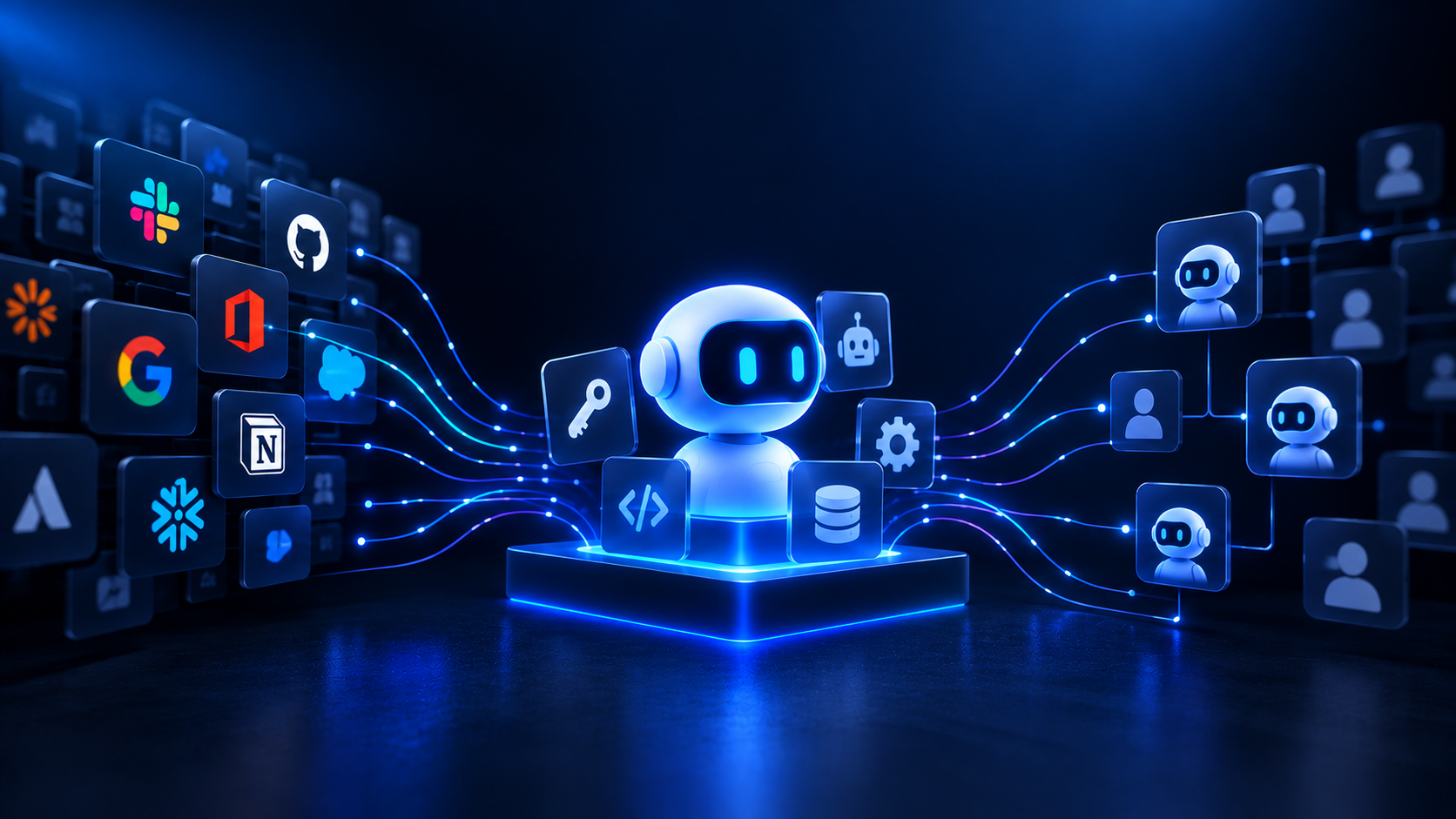
Now organizations face a new reality. SaaS environments have become identity-driven ecosystems where AI systems, OAuth integrations, service accounts, non-human identities, and thousands of interconnected applications operate beyond the scope of traditional security models.
As a result, security leaders are beginning to move beyond standalone posture management toward a broader operating model: the SaaS Security Control Plane (SSCP).
This evolution reflects a fundamental change in enterprise risk. According to Grip Security's 2026 SaaS + AI Security Report:
- The average enterprise operates 3,891 SaaS and AI-connected environments.
- More than two-thirds of organizations contain risky OAuth permission scopes.
The question is no longer whether organizations have visibility into SaaS applications.
The question is whether they can continuously govern identities, access, AI systems, and risk across the entire SaaS ecosystem.
Key Takeaways
- CASBs were built to monitor cloud usage and data movement.
- SSPMs were built to secure SaaS configurations and posture.
- Identity has become the primary attack surface in modern SaaS environments.
- AI adoption has dramatically expanded SaaS risk exposure.
- OAuth connections, service accounts, and non-human identities increasingly operate outside traditional security controls.
- SaaS Security Control Planes (SSCPs) represent the next evolution of SaaS security architecture.
- Future-ready security programs require visibility, governance, and continuous control across identities, applications, and AI systems.
What Is CASB?
Cloud Access Security Brokers emerged as organizations began migrating workloads from on-premises infrastructure to cloud applications.
The primary objective of a CASB was visibility.
Security teams needed to answer questions such as:
- Which cloud applications are employees using?
- What data is leaving the organization?
- Which applications create compliance concerns?
- How can cloud usage be governed consistently?
CASBs introduced important capabilities:
- Data loss prevention (DLP)
- Cloud activity visibility
For many years, CASBs served as the primary layer between users and cloud services.
However, the SaaS ecosystem continued to evolve.
Organizations moved from dozens of cloud applications to hundreds and eventually thousands.
As SaaS adoption accelerated, visibility alone became insufficient.
What Is SSPM?
SaaS Security Posture Management (SSPM) emerged to address a different challenge.
Security teams discovered that many SaaS breaches were caused not by unauthorized applications but by misconfigured applications.
Examples included:
- Excessive administrator privileges
- Disabled security controls
- Misconfigured sharing settings
- Weak authentication policies
SSPM platforms provide continuous monitoring of SaaS security posture across business applications.
Core SSPM capabilities include:
- Security benchmark assessment
- Continuous posture management
SSPM significantly improved SaaS security by helping organizations identify misconfigurations before attackers could exploit them.
However, posture management alone does not address how identities interact across applications.
That challenge created the next phase of SaaS security.
Why Identity Changed SaaS Security
Modern SaaS environments are fundamentally identity-driven.
Every application, integration, AI assistant, service account, API connection, and OAuth grant depends on identity.
This shift transformed the security landscape.
Today, attackers frequently bypass traditional perimeter defenses and exploit:
- Excessive access privileges
The result is that access itself has become the new attack surface.
A SaaS application may be perfectly configured while still introducing significant risk through delegated permissions and identity relationships.
This explains why modern security teams increasingly focus on:
- Non-human identity management
As discussed in our guides on SaaS Identity Is the New Security Perimeter, OAuth Risk Explained, and What Are Non-Human Identities?, identity visibility has become foundational to modern SaaS security.
What Is a SaaS Security Control Plane (SSCP)?
A SaaS Security Control Plane (SSCP) extends beyond posture management.
Rather than simply identifying security issues, an SSCP provides centralized visibility, governance, and control across the SaaS ecosystem.
An SSCP connects:
The SaaS Security Evolution Framework
| Generation |
Primary Focus |
Core Question |
| CASB |
Visibility |
What cloud applications are being used? |
| SSPM |
Posture |
Are applications securely configured? |
| SSCP |
Control |
How do identities, AI systems, and applications interact across the environment? |
The control plane model shifts security from reactive discovery toward continuous governance.
Why AI Changed the Conversation Again
AI has accelerated the need for a new security architecture.
According to Grip's 2026 SaaS + AI Security Report:
- 100% of enterprise environments analyzed contained embedded AI capabilities.
- The average organization operated more than 139 AI-enabled SaaS environments.
- Over 23,000 SaaS applications operated outside centralized IT visibility.
AI is no longer a standalone technology category.
AI is increasingly embedded inside SaaS platforms employees already use every day.
This creates new governance challenges:
- Third-party AI integrations
- AI-driven automation risks
Organizations attempting to govern AI without understanding access relationships face significant blind spots.
This is why AI governance increasingly overlaps with identity governance.
For a deeper examination, see:
CASB vs SSPM Comparison Table
| Capability |
CASB |
SSPM |
| Shadow IT Discovery | ✓ | Limited |
| Data Loss Prevention | ✓ | No |
| Cloud Usage Monitoring | ✓ | Limited |
| SaaS Configuration Monitoring | Limited | ✓ |
| Security Benchmark Assessment | Limited | ✓ |
| Misconfiguration Detection | Limited | ✓ |
| Continuous Posture Monitoring | No | ✓ |
| SaaS Security Risk Assessment | Limited | ✓ |
SSPM vs SSCP Comparison Table
| Capability |
SSPM |
SSCP |
| Configuration Monitoring | ✓ | ✓ |
| Identity Visibility | Limited | ✓ |
| OAuth Governance | Limited | ✓ |
| Non-Human Identity Visibility | Limited | ✓ |
| AI Application Discovery | Limited | ✓ |
| Continuous Risk Governance | Limited | ✓ |
| Cross-App Relationship Analysis | No | ✓ |
| Unified SaaS Security Architecture | No | ✓ |
Which Approach Is Right for Enterprises in 2026?
The answer depends on organizational maturity.
Organizations focused on configuration security may still gain significant value from SSPM.
However, enterprises managing:
increasingly require a broader control plane approach.
The largest challenge is no longer identifying individual application risks.
It is understanding how risk propagates across identities, applications, permissions, integrations, and AI systems.
For many organizations, SSPM represents an important capability.
An SSCP represents the operating model needed to manage modern SaaS risk at scale.
Future of SaaS Security
The future of SaaS security will be defined by three converging forces:
1. Identity-Centric Security
Security decisions will increasingly revolve around identities rather than network boundaries.
2. Continuous AI Governance
AI governance will become a continuous operational process rather than a policy exercise.
Organizations will consolidate visibility, governance, posture management, identity controls, and AI risk management into unified security platforms.
The direction is clear.
Security architectures will continue moving away from isolated tools and toward integrated control planes capable of managing SaaS, identities, and AI as a single ecosystem.
FAQ
What is the difference between CASB and SSPM?
CASBs focus on cloud application visibility, access control, and data protection. SSPMs focus on securing SaaS application configurations and posture.
Is SSPM replacing CASB?
Not entirely. SSPM addresses security challenges that CASBs were not designed to solve. Many organizations use both.
What is a SaaS Security Control Plane?
A SaaS Security Control Plane (SSCP) is an architectural approach that provides visibility, governance, and control across SaaS applications, identities, OAuth integrations, non-human identities, and AI systems.
Why is identity important in SaaS security?
Most modern SaaS attacks exploit identities, permissions, tokens, or delegated access rather than infrastructure vulnerabilities.
How does AI impact SaaS security?
AI expands risk through embedded AI features, data access, automation workflows, third-party integrations, and increased governance complexity.
What should security leaders prioritize in 2026?
Security leaders should prioritize identity visibility, AI governance, OAuth security, non-human identity management, and continuous risk governance across the entire SaaS ecosystem.