Aug 6, 2026
Identity Sprawl in AI Environments: Why AI Agents Change the Equation


Learn how AI agents accelerate identity sprawl and why security teams need continuous visibility into NHIs, permissions, ownership, and access.

Aug 6, 2026
Learn how AI agents accelerate identity sprawl and why security teams need continuous visibility into NHIs, permissions, ownership, and access.
Identity sprawl in AI environments occurs when human and non-human identities, permissions, credentials, integrations, and access relationships grow faster than an organization can discover, attribute, govern, and retire them.
AI agents are accelerating this problem. Unlike employees, agents can be created quickly, operate continuously, connect multiple SaaS applications, and act through OAuth grants, API credentials, tokens, and other persistent forms of access.
Grip Security's 2026 Mid-Year AI Exposure Update found one AI agent for every 17 identities. This Rule of 17 signals an important change in enterprise identity. Security teams are no longer governing a relatively predictable population of employees with machine identities operating in the background. Autonomous identities are becoming a material part of the enterprise access landscape.
The challenge is maintaining visibility, ownership, least privilege, and lifecycle control as that population grows.
Identity sprawl is the growth of identities, credentials, permissions, and access relationships beyond an organization's ability to consistently discover, understand, and govern them.
Enterprise identity was already becoming more complex before widespread adoption of AI.
Employees and contractors accumulate accounts across SaaS applications. Applications communicate through APIs. Automation relies on service accounts. Integrations use OAuth grants and tokens. Machine identities operate in the background to connect systems and execute workflows.
Each new identity can introduce another set of permissions and access relationships that security teams need to understand.
AI adds a new dimension to this problem.
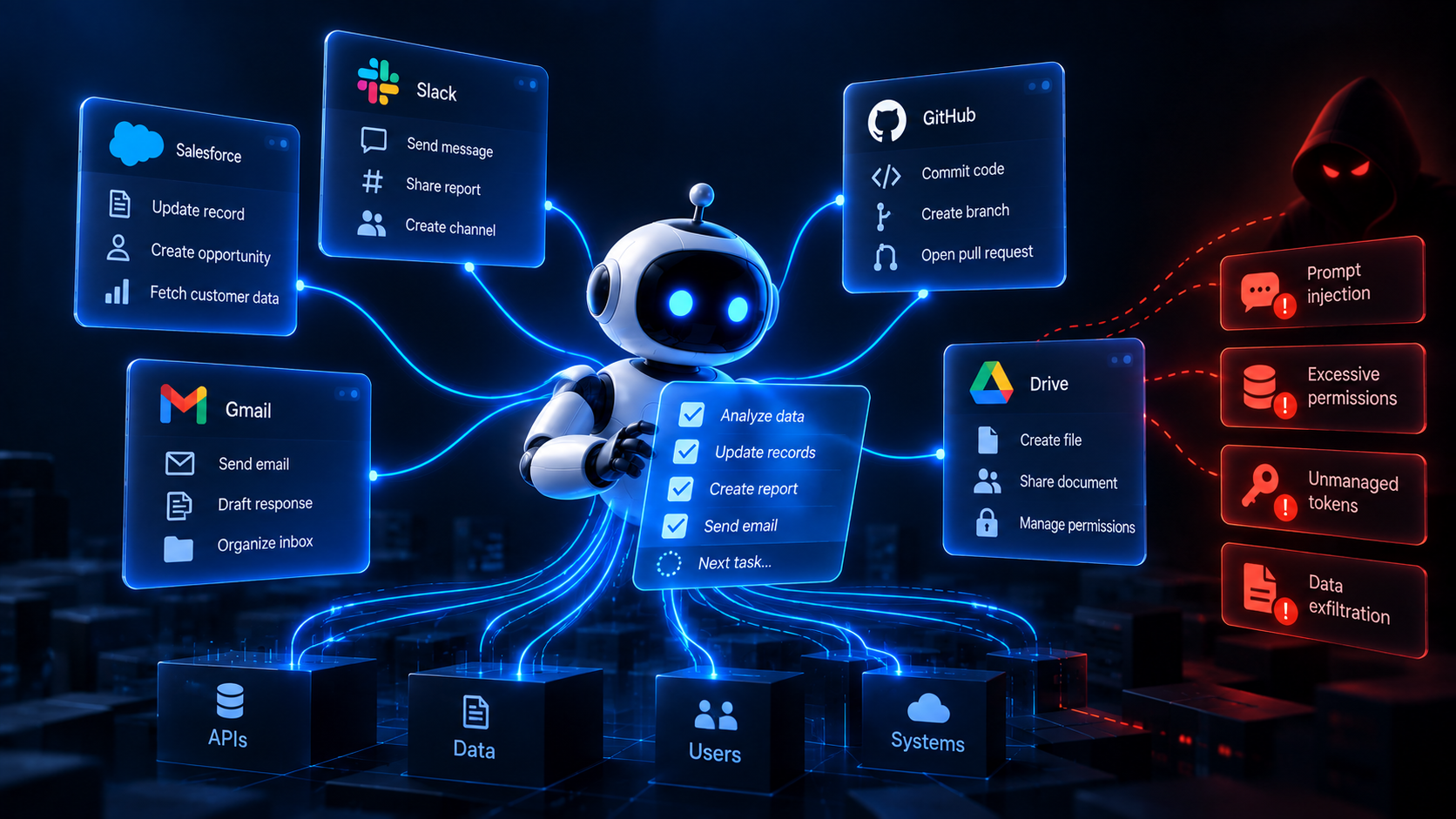
AI agents can act as non-human identities with the ability to access applications, retrieve information, invoke APIs, execute workflows, and perform actions on behalf of people or systems. As organizations deploy more agents, identity growth increasingly reflects autonomous software as well as human users.
AI identity sprawl is the proliferation of AI agents and their associated identities, credentials, permissions, and access relationships faster than organizations can effectively govern them.
That distinction matters because the enterprise identity population itself is changing.
Human identities tend to follow relatively predictable patterns.
An employee joins an organization, receives access, changes roles, gains or loses permissions, and eventually leaves. Those transitions are not always perfectly governed, but the lifecycle has recognizable milestones.
AI agents operate differently.
An agent may be created inside an application, connected to several other SaaS services, authorized through OAuth, and given access to company data. It may perform actions continuously without an interactive login. Another agent may be created days later for a different workflow.
This makes the growth of non-human identities a first-order governance challenge.
Grip Security's 2026 Mid-Year AI Exposure Update found one AI agent for every 17 identities.
The Rule of 17 has practical consequences.
An identity inventory that focuses primarily on employees will provide an increasingly incomplete view of enterprise access. Access reviews need to account for agents as well as users. Security teams need to establish ownership for identities that may not map cleanly to an employee. Least-privilege decisions need to consider what autonomous systems can do, not simply what applications employees can open.
Lifecycle management also becomes harder. An employee departure provides a clear trigger for access removal. An AI agent may have no equivalent event.
Its original project may end while its credentials, integrations, and permissions remain active.
The underlying issue is therefore larger than the number of agents being deployed.
Every autonomous identity can introduce a new set of persistent access relationships that must be discovered, attributed, reviewed, and eventually retired.
AI identity sprawl rarely appears as a neat inventory of agents.
It develops through layers of access.
Consider an employee enabling an AI-powered workflow inside a SaaS application. The workflow might use an AI agent to retrieve information from another application, send data to a third service, and trigger an automated action elsewhere.
To the employee, it may appear to be one workflow.
From an identity perspective, it can involve multiple relationships:
The scale of AI-enabled SaaS makes these relationships increasingly important. Grip's 2026 Mid-Year AI Exposure Update found that 54% of enterprise applications contain detectable AI functionality. This broader AI sprawl creates an expanding set of identities and access relationships for security teams to govern.
That means AI exposure is not limited to a small collection of recognizable AI applications. AI capabilities are becoming embedded throughout the SaaS environment.
As agents, integrations, OAuth connections, and automation multiply, the number of access relationships can grow much faster than the number of applications visible to an employee.
This is why application inventory alone cannot provide a complete picture of AI identity risk.
More identities do not automatically mean more risk.
The problem begins when organizations lose context and control.
Security teams need to know who or what owns an identity, why it exists, what applications and data it can access, what permissions it holds, how it authenticates, and whether that access is still required.
Without that context, AI identity sprawl can produce several forms of exposure.
Unknown ownership. An agent, service account, or integration may remain active even when no current employee is clearly responsible for it.
Excessive permissions. Agents may receive broader permissions than their workflows actually require, increasing the potential impact of misuse or compromise.
Orphaned identities. A project or workflow can disappear while the identity created to support it remains.
Dormant credentials. API keys and other credentials may persist after their original business purpose ends.
Long-lived tokens. OAuth and other authorization tokens can maintain access without requiring repeated user interaction.
Permission drift. Access can expand or change as applications, integrations, and business requirements evolve.
Unmonitored machine-to-machine access. Data may move between applications through automated processes that are less visible than interactive user activity.
These conditions can increase the likelihood of sensitive data being accessible through relationships that security teams do not fully understand.
Identity sprawl becomes security risk when access outlives visibility, ownership, or business purpose.
That principle applies to both human and non-human identities, but autonomous systems make continuous visibility increasingly important.
Human identity governance often follows the familiar:
Joiner → Mover → Leaver
A person joins the company, changes roles, and eventually leaves. Each event can trigger changes to access.
AI agents and other non-human identities do not necessarily have comparable lifecycle events.
An agent may be created through an application or automation workflow rather than a centralized provisioning process. Its owner might be a developer, business team, application administrator, or another system.
Its business purpose can change without its identity changing.
Its credentials may remain valid even after the workflow stops being used.
Its permissions may expand as integrations evolve.
And unlike an employee, an AI agent never resigns.
Without an explicit retirement process, an agent or its associated credentials can persist indefinitely.
Traditional IAM remains essential for governing workforce access. AI environments, however, require additional capabilities for discovering and governing identities and access relationships that do not fit neatly into employee lifecycle processes.
Security teams need to continuously identify these identities, establish ownership, understand their permissions, and determine when access is no longer justified.
Organizations can approach AI identity sprawl through six connected activities.
Continuously identify human identities, non-human identities, AI agents, OAuth grants, service accounts, tokens, credentials, and SaaS integrations.
Discovery needs to account for identities created outside traditional provisioning processes.
Determine who owns each identity and what business purpose it serves.
An identity without clear ownership is difficult to review, govern, or safely retire.
Understanding AI access requires security teams to determine which applications, permissions, systems, and data an identity can reach
Security teams should be able to determine which applications, permissions, systems, and data an identity can reach, including relationships created through OAuth and APIs.
Apply least-privilege principles, access policies, approval processes, and appropriate lifecycle controls.
Governance should reflect what an identity actually needs to perform its intended function.
Remove dormant identities, stale integrations, unnecessary credentials, and excessive permissions when their business purpose ends.
Retirement should be treated as a lifecycle requirement rather than an occasional cleanup exercise.
Continuously reassess identities and their access as applications, agents, permissions, and workflows change.
In dynamic SaaS environments, an accurate identity inventory is temporary unless it is continuously maintained.
Together, these activities shift identity governance from periodic inventory toward continuous control.
AI governance cannot stop at policies governing which AI tools employees may use.
Organizations also need to understand how AI interacts with enterprise systems and data.
That requires answering practical identity questions:
Without those answers, organizations may have an AI governance policy without visibility into the access that makes AI operational.
This is why identity is becoming a control plane for AI risk.
Governance determines what should be permitted. Identity and access relationships reveal what AI systems can actually do.
As agents become more autonomous, closing the gap between those two views becomes increasingly important.
Grip's Rule of 17 points to a structural shift in enterprise identity: for every 17 identities, there is now one AI agent.
The significance is not simply that organizations have more identities to manage.
AI agents change the composition and behavior of the identity environment. They can operate continuously, authenticate through persistent credentials, connect multiple SaaS applications, and retain access without the lifecycle signals organizations traditionally use to govern employees.
As autonomous identities multiply, security teams need continuous visibility into ownership, permissions, access relationships, persistence, and business purpose.
The organizations best positioned to control AI identity sprawl will be those that can continuously discover identities, understand what they can access, govern them according to risk, and retire access when it is no longer needed.
AI is changing enterprise identity. Identity governance must evolve with it.
Identity sprawl is the uncontrolled growth of identities, credentials, permissions, and access relationships beyond an organization's ability to consistently discover, understand, and govern them. It can include employees, contractors, service accounts, applications, APIs, automation, integrations, and other non-human identities.
AI identity sprawl is the proliferation of AI agents and their associated identities, credentials, permissions, and access relationships faster than organizations can effectively govern them. It occurs as AI agents become embedded across SaaS applications and automated workflows.
AI agents can operate continuously, act autonomously, connect multiple applications, and maintain persistent access through OAuth grants, API credentials, tokens, and integrations. Risk increases when organizations cannot determine who owns an agent, what it can access, why its permissions exist, or when those permissions should expire.
Organizations should continuously discover non-human identities, establish ownership and business purpose, map permissions and access relationships, enforce least privilege, retire unnecessary identities and credentials, and monitor for changes over time.