Jul 15, 2026
How SSPM Reduces Compliance Drift in Regulated SaaS


Learn how SSPM reduces compliance drift with continuous visibility into SaaS configurations, identities, permissions, and AI apps.

Jul 15, 2026
Learn how SSPM reduces compliance drift with continuous visibility into SaaS configurations, identities, permissions, and AI apps.
Compliance in SaaS environments is not a point-in-time achievement. It is a continuously changing state.
Every new user, permission change, OAuth grant, SaaS integration, AI-enabled application, and non-human identity can alter an organization's security and compliance posture. In regulated environments, those changes can create gaps between approved controls and the reality of how applications, identities, and data are actually being used.
This gap is compliance drift.
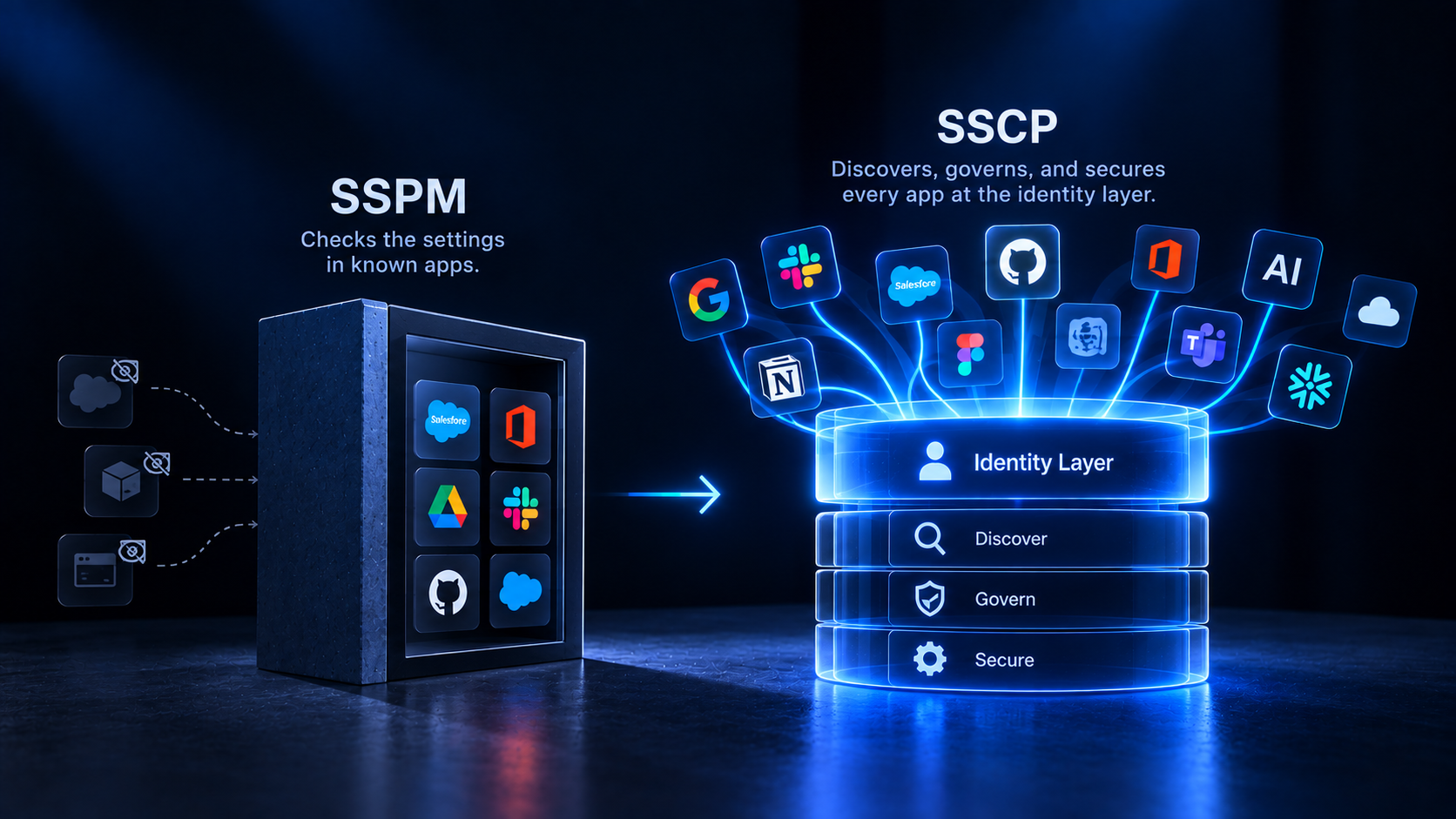
SaaS Security Posture Management (SSPM) helps organizations reduce compliance drift by continuously monitoring SaaS environments for changes that introduce security or governance risk. But modern SSPM must look beyond static application settings. As AI becomes embedded across SaaS, organizations increasingly need visibility into identities, permissions, integrations, AI functionality, and automated actors as well.
Grip Security research illustrates the scale of that challenge. AI-related attacks increased approximately 490% year over year, while roughly 80% of incidents involved sensitive or regulated data. At the same time, 54% of enterprise applications now contain AI functionality, and the average Grip customer uses 1,017 AI-enabled applications.
For regulated organizations, periodic compliance assessments alone cannot keep pace with this rate of change.
Continuous compliance increasingly requires continuous control.
Quotable insight: Compliance drift is not simply configuration drift. It is the growing distance between documented controls and the constantly changing reality of SaaS access.
Compliance drift occurs when an organization's technology environment gradually moves away from an approved, compliant state.
Consider a SaaS application that passes a compliance assessment today. Its security settings may be properly configured, administrative privileges tightly controlled, and integrations appropriately approved.
Then the environment changes.
An administrator grants elevated permissions to another employee. A user connects an external application through OAuth. A service account remains active after its original purpose disappears. A SaaS vendor introduces new AI functionality. An employee enables an AI integration that can access sensitive information.
Individually, these changes may appear routine. Collectively, they can create material differences between the environment that was assessed and the environment that exists today.
Traditional compliance programs frequently identify these gaps through scheduled reviews or audits. But in rapidly changing SaaS environments, a quarterly or annual review may discover drift months after it occurred.
That is why continuous compliance has become increasingly important.
Continuous compliance applies ongoing monitoring and governance to help organizations determine whether technical controls remain aligned with internal policies and regulatory requirements as environments change.
SaaS fundamentally changed the rate at which enterprise technology environments evolve.
Applications can be adopted without centralized deployment. Employees can authorize integrations without security teams configuring them. Permissions can change instantly. SaaS vendors continuously release functionality.
AI is accelerating this dynamic further.
Grip's Mid-Year AI Exposure Update found that 54% of enterprise applications contain AI functionality. Users are exposed to an average of 33.5 AI-enabled applications, while the average Grip customer uses 1,017 AI-enabled applications.
That means AI governance is no longer limited to a small number of dedicated generative AI platforms. AI capabilities are increasingly embedded throughout the existing SaaS estate.
Machine identities are expanding as well.
Grip's Rule of 17 describes a new enterprise reality: organizations now have approximately one AI agent for every 17 identities.
These agents join service accounts, API credentials, OAuth integrations, automation tools, and other non-human identities as actors capable of accessing applications and data.
This creates a compliance environment in which change is both faster and harder to see.
The consequences can be significant. Grip's 2026 SaaS + AI Security Report found that AI-related attacks increased approximately 490% year over year, while roughly 80% of incidents involved sensitive or regulated data.
For regulated organizations, the implication is clear:
Quotable insight: The faster identities, applications, and AI capabilities change, the shorter the useful life of a point-in-time compliance assessment.
SaaS Security Posture Management helps organizations continuously evaluate SaaS applications for security and governance risks.
At its most basic level, SSPM can identify configuration changes that move applications away from established security baselines. Examples might include weakened authentication requirements, changes to administrative controls, inappropriate external sharing, or other risky settings.
Modern SaaS environments require a broader view.
Effective SSPM should help security teams understand changes across several interconnected layers:
Application posture: Are SaaS security controls configured according to organizational policies?
Identity posture: Who has access, and are privileges appropriate for the user's role?
OAuth and integrations: Which third-party applications have been authorized, and what permissions have they received?
Non-human identities: Which service accounts, agents, API connections, and automated identities can access enterprise systems?
AI exposure: Where has AI functionality been introduced, and what data or permissions can those capabilities access?
Connecting these signals gives organizations a much more complete picture of compliance drift than configuration monitoring alone.
For example, an application may technically remain configured according to policy while a newly authorized OAuth integration gains access to sensitive information. From a configuration perspective, little may have changed. From a governance perspective, the organization's exposure has changed materially.
This is why understanding OAuth risk and recognizing that SaaS identity is the new security perimeter are increasingly important components of SaaS compliance.
Periodic reviews remain important. Continuous monitoring does not eliminate audits, assessments, or compliance teams.
Instead, it reduces the amount of unknown change that can accumulate between them.
The connection between AI, identity, and compliance is becoming increasingly important.
An AI-enabled application does not become risky simply because it contains AI. Risk depends on what the application can access, what identities interact with it, what permissions have been granted, and how data can move through it.
This makes identity context essential to AI risk management in SaaS.
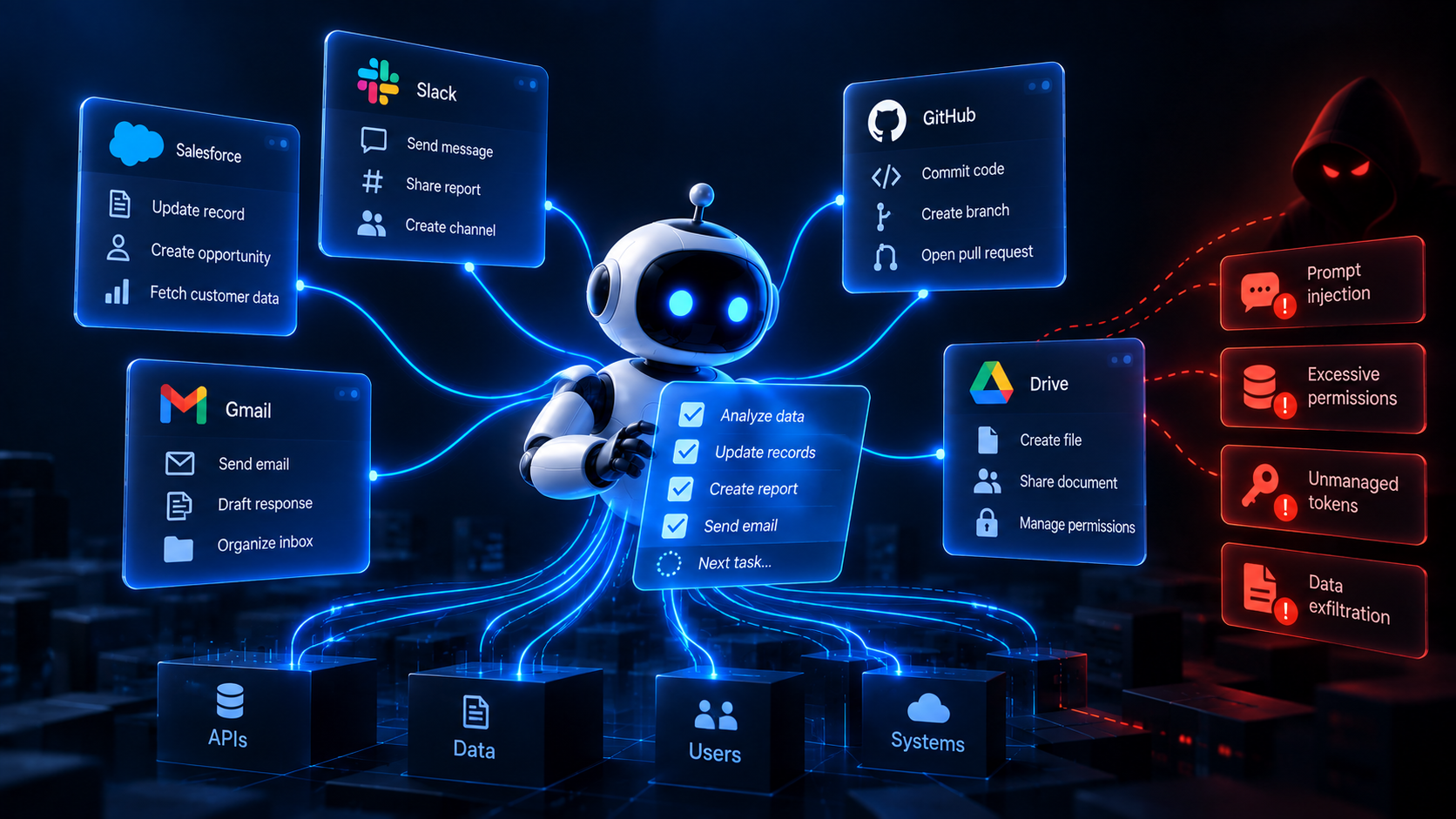
Consider an AI agent connected to several SaaS platforms. Depending on its permissions, it may be able to retrieve customer records, summarize internal documents, modify workflows, or act on behalf of a user.
From a compliance perspective, important questions include:
The same questions apply to OAuth integrations and other non-human identities.
As AI sprawl becomes the new SaaS sprawl, security teams therefore need more than an inventory of AI applications. They need visibility into the identity and access relationships surrounding those applications.
Quotable insight: AI governance becomes a compliance problem when organizations can identify AI applications but cannot determine what those applications and agents can access.
Continuous monitoring tells an organization what changed.
Continuous governance determines what should happen next.
That distinction is critical.
An SSPM platform might detect excessive administrative privileges, an unapproved OAuth grant, or a risky configuration. But identifying a problem does not restore compliance. Someone—or something—must evaluate the finding, prioritize it, assign ownership, and remediate the issue.
This is where mature governance programs increasingly move toward automated policy enforcement and remediation.
A useful continuous compliance maturity framework can be viewed in four stages:
Stage 1 — Periodic Assessment: Compliance posture is primarily evaluated during scheduled audits or reviews.
Stage 2 — Continuous Visibility: Security teams continuously discover applications, configurations, identities, and relevant changes.
Stage 3 — Continuous Governance: Findings are evaluated against defined policies with ownership and remediation workflows.
Stage 4 — Continuous Control: High-confidence policy violations can trigger automated or orchestrated remediation, with appropriate oversight and auditability.
This progression reflects a broader evolution in SaaS and AI governance.
Visibility answers what exists.
Identity context answers who or what has access.
Governance determines what should be allowed.
Continuous control helps ensure the environment remains aligned with those decisions.
That is the progression from AI Risk → Identity → Governance → Continuous Control.
Organizations looking to strengthen continuous compliance across SaaS should prioritize a few foundational capabilities.
1. Establish a continuously updated SaaS inventory.
Organizations cannot govern applications they do not know exist. Discovery should account for sanctioned SaaS, shadow SaaS, AI-enabled applications, and integrations.
2. Map compliance controls to observable technical signals.
Translate policies into configurations, permissions, identities, and behaviors that can actually be monitored.
3. Add identity context to posture management.
Configuration findings become more actionable when teams understand which human and non-human identities are affected and what privileges they possess.
4. Continuously evaluate OAuth and third-party access.
OAuth grants can create persistent access paths that are easy to overlook during configuration-focused assessments.
5. Include AI functionality in SaaS governance.
With 54% of enterprise applications containing AI capabilities, separating "AI governance" from broader SaaS governance is increasingly impractical.
6. Prioritize remediation by business and data risk.
A compliance finding involving sensitive or regulated information should generally receive greater urgency than an equivalent issue affecting low-risk data.
7. Automate remediation where confidence is high.
Repeatable violations with clear policy outcomes are strong candidates for automated remediation, while ambiguous or high-impact decisions can remain subject to human review.
Organizations evaluating an { should therefore consider not only whether it discovers AI applications, but whether it connects AI exposure to identities, permissions, data access, governance policies, and remediation.
SSPM compliance refers to using SaaS Security Posture Management capabilities to continuously identify SaaS configurations, permissions, identities, and other conditions that may diverge from organizational security policies or compliance requirements.
Compliance drift is the gradual divergence between an organization's approved compliance posture and its actual SaaS environment. It can result from configuration changes, new identities, excessive permissions, OAuth grants, integrations, AI functionality, and other ongoing changes.
SSPM supports continuous compliance by continuously monitoring SaaS environments for changes that may create security or governance gaps. More advanced approaches add identity, integration, AI, and remediation context to traditional configuration monitoring.
No. SSPM complements audits by providing continuous visibility between formal assessments. This can help organizations identify and remediate control gaps earlier while improving ongoing audit readiness.
AI expands compliance complexity because AI capabilities are increasingly embedded into existing SaaS applications and accessed by both human and non-human identities. New agents, integrations, permissions, and data-access relationships can alter an organization's risk posture without requiring a traditional application deployment.
Organizations should evaluate whether an SSPM platform provides continuous SaaS discovery, configuration monitoring, identity and permission context, OAuth visibility, non-human identity coverage, AI application visibility, policy-based governance, remediation workflows, and evidence that can support compliance processes.
Regulated organizations will always need frameworks, policies, assessments, and audits. What is changing is the environment those controls must govern.
SaaS applications evolve continuously. Identities and permissions change continuously. OAuth integrations create new access paths. AI functionality appears inside existing applications. AI agents introduce a rapidly growing class of non-human identities.
Compliance programs must evolve accordingly.
SSPM provides an important foundation by helping organizations detect when SaaS environments move away from intended security and governance states. But the long-term objective is broader than posture monitoring.
Organizations need to understand their AI and SaaS environments, connect applications to identities and access, apply governance continuously, and remediate risk when controls drift.
In an environment that never stops changing, compliance cannot remain a periodic snapshot.
Continuous environments require continuous control.