Aug 11, 2026
How to Build an AI Governance Program That Actually Enforces Policy


Learn how to build an AI governance program that turns policy into enforceable controls across AI, identities, permissions, OAuth, and SaaS.

Aug 11, 2026
Learn how to build an AI governance program that turns policy into enforceable controls across AI, identities, permissions, OAuth, and SaaS.
AI governance programs are becoming standard across the enterprise. Organizations are establishing acceptable-use policies, governance committees, approved AI tool lists, vendor assessments, and risk-review processes.
Those are important foundations. The harder challenge is turning governance decisions into controls that can actually be enforced.
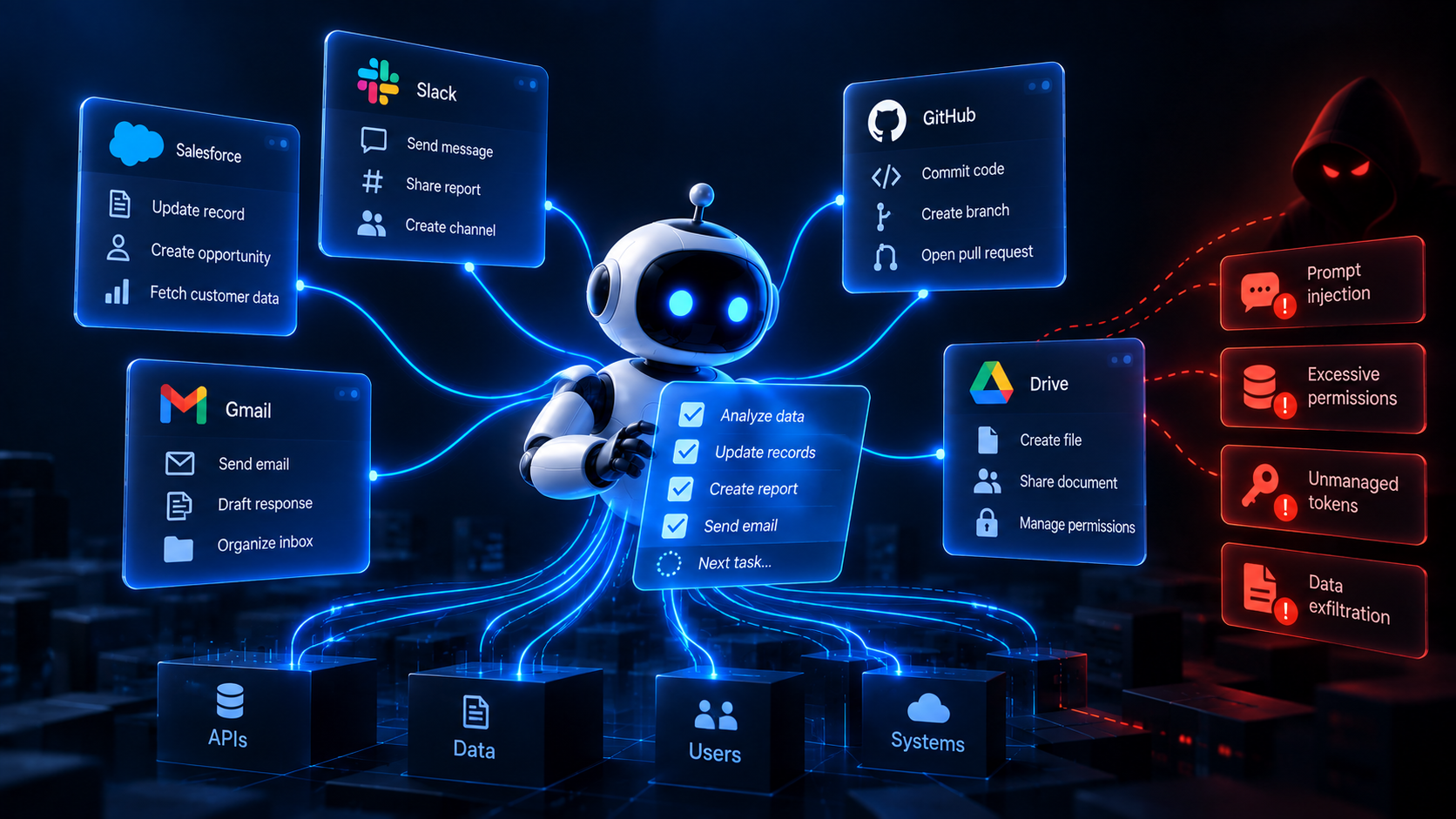
AI adoption now extends far beyond a list of approved applications. AI capabilities are embedded into SaaS platforms, connected through OAuth, introduced through browser-based tools, and increasingly operated by AI agents and other non-human identities (NHIs). Each can create new relationships between identities, applications, permissions, and enterprise data.
An effective AI governance program must account for those relationships and control them.
An effective AI governance program connects five capabilities:
Discovery → Risk Context → Policy → Enforcement → Continuous Monitoring
Organizations first need to discover where AI is operating, including standalone applications, embedded AI, integrations, and AI agents. They then need identity and access context to understand who or what is using AI, what permissions exist, and what data can be reached.
That context allows security teams to establish risk-based policies and translate them into technical controls, such as reducing excessive permissions, revoking unnecessary OAuth grants, or remediating unowned AI agents.
Finally, organizations must continuously monitor the environment for new applications, identities, permissions, integrations, and policy violations.
AI governance becomes meaningful when policy can change what is actually allowed in the environment.
Most organizations do not have a policy problem. They have a visibility and enforcement problem.
An acceptable-use policy can establish how employees should use AI. An approved-tool list can guide procurement. A governance committee can evaluate high-risk use cases. Vendor assessments can help determine whether an AI provider meets organizational requirements.
Each serves an important purpose.
The difficulty is that enterprise AI adoption increasingly occurs outside these formal processes.
A SaaS provider may introduce an AI feature into an application already used by thousands of employees. A user can authorize an AI service through OAuth. An integration can provide persistent access to enterprise data. An AI agent may operate through a non-human identity with permissions spanning several systems.
Meanwhile, periodic reviews capture the environment at a particular moment even as SaaS environments continue changing.
Grip's 2026 observations illustrate the scale of the challenge. More than half of enterprise applications, 54%, now contain detectable AI functionality, and the average Grip customer uses 1,017 AI-enabled applications.
An approved-tool list cannot provide a complete picture when AI functionality is distributed this broadly.
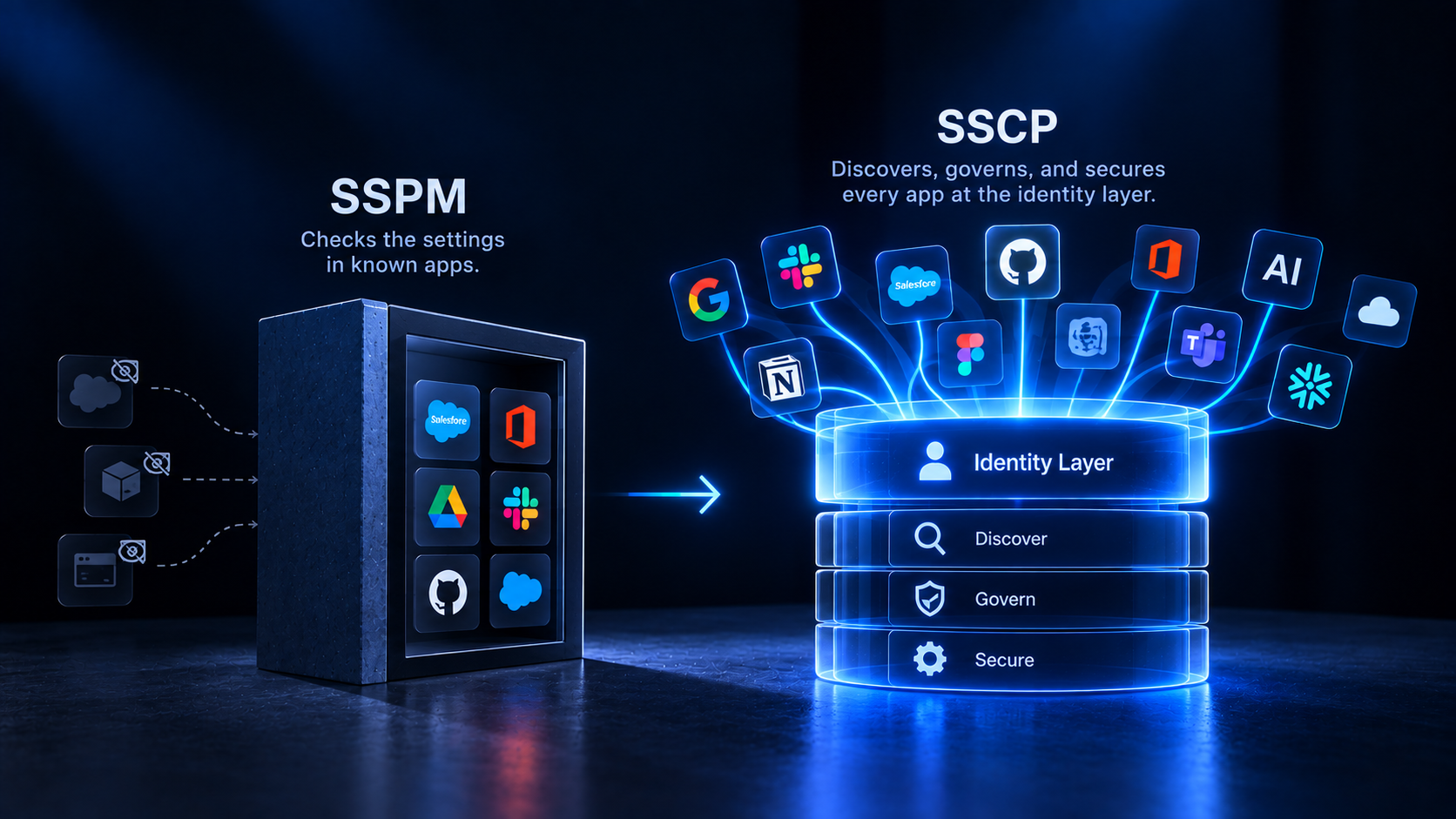
Governance therefore needs an operational layer capable of discovering AI, understanding its access, applying policy, and identifying when the environment moves out of compliance.
A practical AI governance program can be built around six steps.
Primary question: Where is AI operating?
Governance starts with visibility.
Organizations need an inventory that extends beyond formally purchased AI applications to include:
This distinction matters because enterprise AI adoption does not always resemble traditional software procurement.
An employee might begin using an AI application directly in the browser. An existing SaaS vendor might add AI functionality to a product already approved by the organization. An AI service could connect to another application through OAuth without creating a traditional software deployment.
If the governance program relies only on procurement records or an approved-vendor inventory, these access paths can remain outside its field of view.
Visibility must precede governance because policy cannot be consistently applied to AI that the organization cannot see.
The goal of discovery is not simply to count AI applications. It is to establish the foundation for understanding where AI intersects with the enterprise environment.
Primary question: Who or what can access what through AI?
Discovery tells security teams where AI exists. Identity and access context tell them whether that AI creates meaningful exposure.
For each relevant AI application, integration, or agent, organizations should understand the surrounding relationships:
This is increasingly important as AI agents become part of enterprise workflows.
Grip's 2026 observations found approximately one AI agent for every 17 identities. As agents proliferate, governance programs have to oversee more than employee behavior. They also need to account for identities capable of operating continuously and accessing systems without direct human interaction.
This context separates AI adoption from AI exposure.
Two AI applications may appear similar in an inventory but present very different risks if one has limited access while the other holds broad OAuth permissions to sensitive SaaS data.
Identity provides the context that makes AI governance enforceable.
Primary question: What should be allowed?
Once organizations understand where AI operates and what it can access, they can define policies based on actual risk.
Governance policies may establish requirements around approved AI use, sensitive-data access, least privilege, OAuth scopes, agent ownership, NHI lifecycle management, regulatory obligations, and high-risk integrations.
The important distinction is that policy should be specific enough to inform a control.
For example, instead of simply stating that AI must be used securely, an organization might establish that AI integrations accessing sensitive applications must use the minimum OAuth scopes necessary for their function.
Similarly, a governance program might require every AI agent or NHI to have an identifiable owner and business purpose.
Risk-based governance also avoids treating every AI application as equally dangerous.
An AI feature with limited permissions and no access to sensitive enterprise data may warrant a different response than an autonomous agent with persistent access across several critical SaaS applications.
The objective is to connect governance requirements to observable conditions in the environment.
Primary question: Can we enforce the policy?
This is where AI governance becomes operational.
Policies establish what should happen. Enforcement determines whether the organization can make it happen.
Depending on the policy and risk, technical controls might include:
Consider a policy requiring AI agents to operate with least privilege.
Documenting that requirement establishes intent. Enforcement requires the organization to identify the permissions associated with those agents, detect when access exceeds what is necessary, and reduce excessive permissions.
The same principle applies to OAuth.
A policy may prohibit AI applications from receiving unnecessary access to sensitive SaaS data. Operational governance requires visibility into OAuth grants and scopes, enough context to determine which access violates policy, and a mechanism for revoking or reducing it.
A governance control is effective when a policy violation can lead to a measurable change in access, permissions, configuration, or behavior.
That does not mean every violation should result in blocking an application. Enforcement should be proportional to risk.
In some cases, remediation may mean reducing a permission. In others, it may mean requiring an owner, reviewing an integration, removing a dormant identity, or restricting access to sensitive data.
The goal is controlled AI adoption, not indiscriminate restriction.
Primary question: Is the environment still aligned with policy?
Enforcement is not a permanent end state.
SaaS environments continuously change. Employees adopt new applications. Vendors add AI features. OAuth grants are created. Permissions expand. Agents are deployed. Integrations change. Owners leave organizations while credentials and NHIs remain active.
A governance decision that was appropriate six months ago may no longer reflect the current environment.
Continuous AI governance should therefore monitor for changes such as:
Continuous monitoring closes the gap between a point-in-time governance decision and the environment that exists today.
It also gives security teams a way to identify governance drift before the next scheduled assessment.
AI governance should be measured by changes in risk and control, not the amount of governance activity performed.
Useful operational measures can include:
These measures help answer a more useful question than how many policies have been written:
Is the governance program reducing uncontrolled AI access and exposure?
The difference between policy and enforcement becomes clearer when governance requirements are translated into observable controls.
The purpose of enforcement is to close the distance between what governance says should happen and what is actually happening across the SaaS environment.
Identity is the bridge between governance intent and technical enforcement.
An AI inventory can tell security teams that an application or agent exists. It cannot, by itself, explain the access relationship that makes the application important from a security perspective.
To enforce governance decisions, organizations need to understand:
This becomes particularly important for OAuth-connected applications, AI agents, service accounts, tokens, and other NHIs.
These identities may retain access long after their original purpose changes. They may also operate without the interactive authentication and lifecycle patterns traditionally associated with human users.
AI governance becomes enforceable when organizations can connect an AI capability to the identity that operates it and the access that identity possesses.
Building an AI governance program is not a one-time implementation project.
Organizations typically progress through a broader maturity path:
Visibility → Context → Governance → Enforcement → Continuous Control
Visibility establishes where AI exists.
Context explains identities, permissions, integrations, and exposure.
Governance determines what should be allowed.
Enforcement translates those decisions into technical controls.
Continuous control ensures those controls keep pace as the environment changes.
The progression matters because attempting to enforce policy without sufficient visibility or context can produce ineffective controls, unnecessary restrictions, or gaps in coverage.
A mature governance program continuously connects policy with the changing technical reality of the SaaS environment.
An AI governance program should ultimately be able to answer three questions:
Where is AI operating?
What can it access and do?
Can we enforce what should and should not be allowed?
Policies, committees, approved-tool lists, and risk reviews establish the organizational foundation for responsible AI adoption. Operational visibility, identity context, access controls, monitoring, and remediation make those decisions durable.
As AI becomes embedded throughout SaaS environments and AI agents take on more autonomous roles, that connection will become increasingly important.
Organizations evaluating whether their current program has the visibility and enforcement capabilities required for this environment can use Grip's Shadow AI Assessment to identify gaps and determine the next steps toward continuous control.
Build an AI governance program by connecting five core capabilities: discovery, risk context, policy, enforcement, and continuous monitoring. Start by identifying where AI operates, map AI to identities and access, establish risk-based policies, translate those policies into technical controls, and continuously monitor for change.
An AI governance program should include AI discovery, identity and access visibility, risk classification, policies for acceptable use and access, technical enforcement capabilities, continuous monitoring, clear ownership, and operational measures for determining whether controls are reducing risk.
Organizations enforce AI governance policies by translating requirements into technical controls. Examples include reducing excessive permissions, revoking unnecessary OAuth grants, restricting sensitive-data access, removing stale integrations, enforcing ownership of AI agents and NHIs, and remediating policy violations.
AI governance typically requires shared responsibility across security, IT, identity, risk, legal, privacy, and business teams. Responsibilities should be clearly defined, but technical enforcement requires security and technology teams to have visibility into the applications, identities, permissions, integrations, and data access affected by governance decisions.