Aug 10, 2026
AI Governance Maturity Model: From Visibility to Continuous Control


Learn the five stages of AI governance maturity, from AI visibility and identity context to enforcement and continuous control.

Aug 10, 2026
Learn the five stages of AI governance maturity, from AI visibility and identity context to enforcement and continuous control.
An AI governance maturity model is a framework organizations can use to assess how effectively they discover AI usage, understand associated risk, establish governance policies, enforce controls, and continuously adapt those controls as AI environments change.
The Grip AI Governance Maturity Model defines five stages of maturity:
Visibility → Context → Governance → Enforcement → Continuous Control
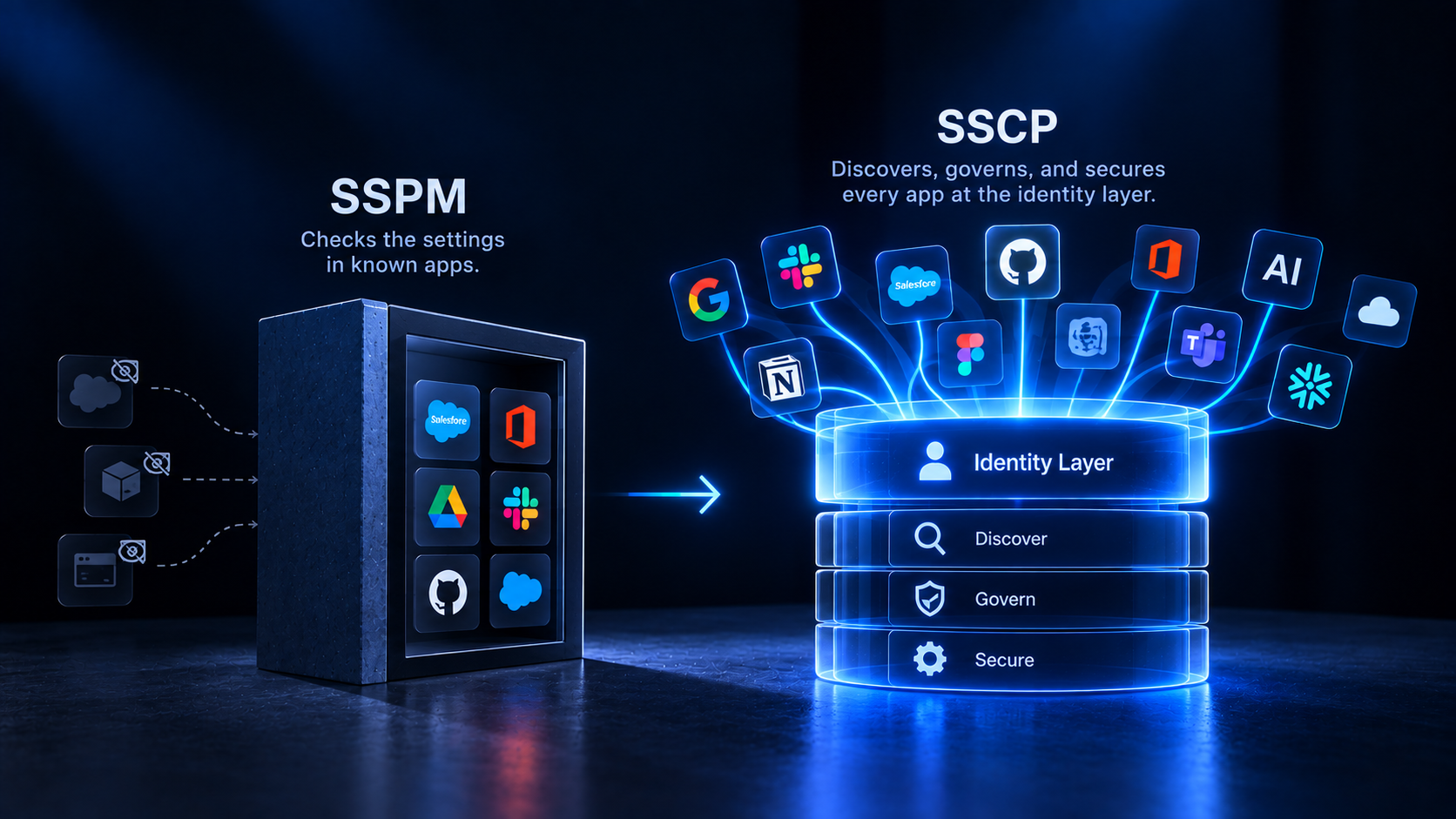
The progression matters because AI governance cannot be measured by policies alone. Organizations need operational capabilities that connect AI applications and agents with the identities, permissions, OAuth grants, integrations, and data they can access.
As AI adoption expands across enterprise SaaS, mature governance means moving from knowing AI exists to continuously understanding and controlling how it operates.
AI governance maturity describes how effectively an organization can turn its AI governance objectives into operational security controls.
Early-stage programs often focus on policies, approved AI application lists, governance committees, and risk reviews. These establish important expectations, but they provide only part of the governance capability an enterprise needs.
AI environments are dynamic. AI can appear through standalone applications, embedded SaaS functionality, browser-based tools, OAuth integrations, AI agents, and SaaS-to-SaaS workflows.
That makes maturity increasingly dependent on whether an organization can understand the relationships surrounding AI:
The practical question is therefore not simply whether an organization has an AI governance framework. It is whether that framework can keep pace with the environment it governs.
The Grip AI Governance Maturity Model organizes this progression into five stages.
Each stage builds on the capabilities established before it.
An organization cannot reliably govern AI it cannot discover. It cannot make informed governance decisions without understanding access. And it cannot achieve continuous control if governance decisions remain disconnected from enforcement.
Primary question: Where is AI operating?
The first stage is establishing visibility into AI across the enterprise.
At this stage, AI inventories are often incomplete. Security teams may know about sanctioned applications while having limited insight into shadow AI, embedded AI capabilities, or tools adopted directly by employees.
Visibility may also remain primarily application-centric. Teams know that an AI application exists, but not necessarily who uses it, how it connects to the SaaS environment, or what it can access.
The scale of this challenge is increasing. Grip's 2026 Mid-Year AI Exposure observations found that 54% of enterprise applications contain detectable AI functionality, illustrating how AI is becoming a characteristic of the broader SaaS environment rather than a discrete application category.
Organizations at Stage 1 should prioritize reliable discovery and inventory. The immediate objective is straightforward: establish an accurate picture of where AI exists.
Visibility is foundational, but visibility by itself does not establish control.
Primary question: What can AI access, and who or what is acting through it?
Once AI has been discovered, organizations need to understand its relationships with identities, applications, permissions, and data.
This is where AI governance becomes an identity problem as much as an application problem.
Organizations at Stage 2 begin mapping AI applications and capabilities to human identities, AI agents, and other non-human identities. They examine OAuth scopes, SaaS integrations, permissions, sensitive-data exposure, and ownership.
The distinction matters because two organizations can discover the same AI application while facing very different levels of risk.
An AI tool with limited access presents a different governance question from an AI agent connected to sensitive enterprise systems through broad OAuth permissions.
The expansion of non-human identities makes this context increasingly important. Grip's 2026 observations identified approximately one AI agent for every 17 identities.
At this stage, governance teams move beyond asking what AI exists and begin understanding what that AI can actually do.
Primary question: What AI usage should be allowed?
With visibility and context established, organizations can make more informed governance decisions.
Stage 3 connects real environmental data to policy.
Capabilities typically include AI risk classification, approved-use policies, ownership requirements, access standards, least-privilege expectations, and governance workflows for reviewing higher-risk applications or use cases.
Context makes those policies more useful.
Instead of treating every AI application equally, organizations can differentiate based on factors such as the data an application can access, the permissions it holds, whether an AI agent operates autonomously, and whether a responsible owner has been identified.
This allows governance to become risk-based rather than inventory-based.
A mature Stage 3 program can answer both what should be allowed and under what conditions it should be allowed.
Primary question: Can we enforce our governance decisions?
Policies establish intent. Enforcement determines whether that intent changes the environment.
At Stage 4, governance decisions become operational security controls.
Organizations develop the ability to reduce excessive permissions, revoke risky OAuth grants, restrict inappropriate AI access, govern non-human identities, and remediate policy violations.
This stage represents an important dividing line in AI governance maturity.
A policy that prohibits certain access patterns provides direction. A governance program that can identify those patterns and take corrective action provides control.
Enforcement does not necessarily mean automatically blocking every violation. Depending on risk and business requirements, organizations may use automated remediation, approval workflows, user engagement, or security-team intervention.
The defining capability is that governance decisions can produce measurable changes to access and risk.
Primary question: Can governance adapt as the environment changes?
AI-enabled SaaS environments do not remain static after a governance review.
New applications appear. Existing SaaS products introduce AI features. Users authorize integrations. OAuth permissions change. AI agents gain new capabilities. Employees change roles. Non-human identities persist after their original owners or purposes disappear.
Stage 5 addresses this continuous change.
Organizations at this level combine continuous discovery with access monitoring, permission-drift detection, AI-agent lifecycle governance, ongoing risk prioritization, and automated or workflow-driven remediation.
The objective is not to automate every security decision.
It is to shorten the gap between environmental change, risk detection, governance decision, and corrective action.
That is what continuous AI governance ultimately means: governance controls evolve as the environment they protect evolves.
Organizations can begin by asking seven practical questions:
Organizations answering primarily yes to the first question are likely operating around Stage 1: Visibility.
Those that can answer the identity, permission, and data-access questions are progressing toward Stage 2: Context.
Organizations that consistently use that context to determine acceptable use have reached Stage 3: Governance.
When those decisions can be translated into access changes and remediation, the organization is moving into Stage 4: Enforcement.
Organizations that can continuously detect change, reassess risk, and respond accordingly are approaching Stage 5: Continuous Control.
The goal is not to assign a perfect maturity score. It is to identify the next capability that will materially improve governance.
One of the most common barriers is incomplete discovery. Governance processes built around known or approved applications struggle when AI also enters the environment through embedded features, browser activity, integrations, and agents.
Application-centric inventories create another limitation. Knowing an application exists provides little information about its actual exposure without identity, permission, integration, and data context.
Operational fragmentation can slow progress further. Identity information may reside in one system, SaaS posture information in another, OAuth activity elsewhere, and governance processes in manual spreadsheets or periodic reviews.
These gaps become particularly significant between Stages 3 and 4.
Organizations may have well-developed policies but lack the technical context or control mechanisms necessary to enforce them.
AI governance becomes progressively more dependent on identity as organizations move through the maturity model.
Visibility can tell a security team that an AI application or capability exists.
Identity context helps answer the questions required to govern it:
Who is using it? Is an AI agent acting autonomously? Which OAuth permissions have been granted? What systems can it reach? Who owns the integration? Does the access remain appropriate? Which credentials or tokens keep that access active?
These questions extend beyond human users.
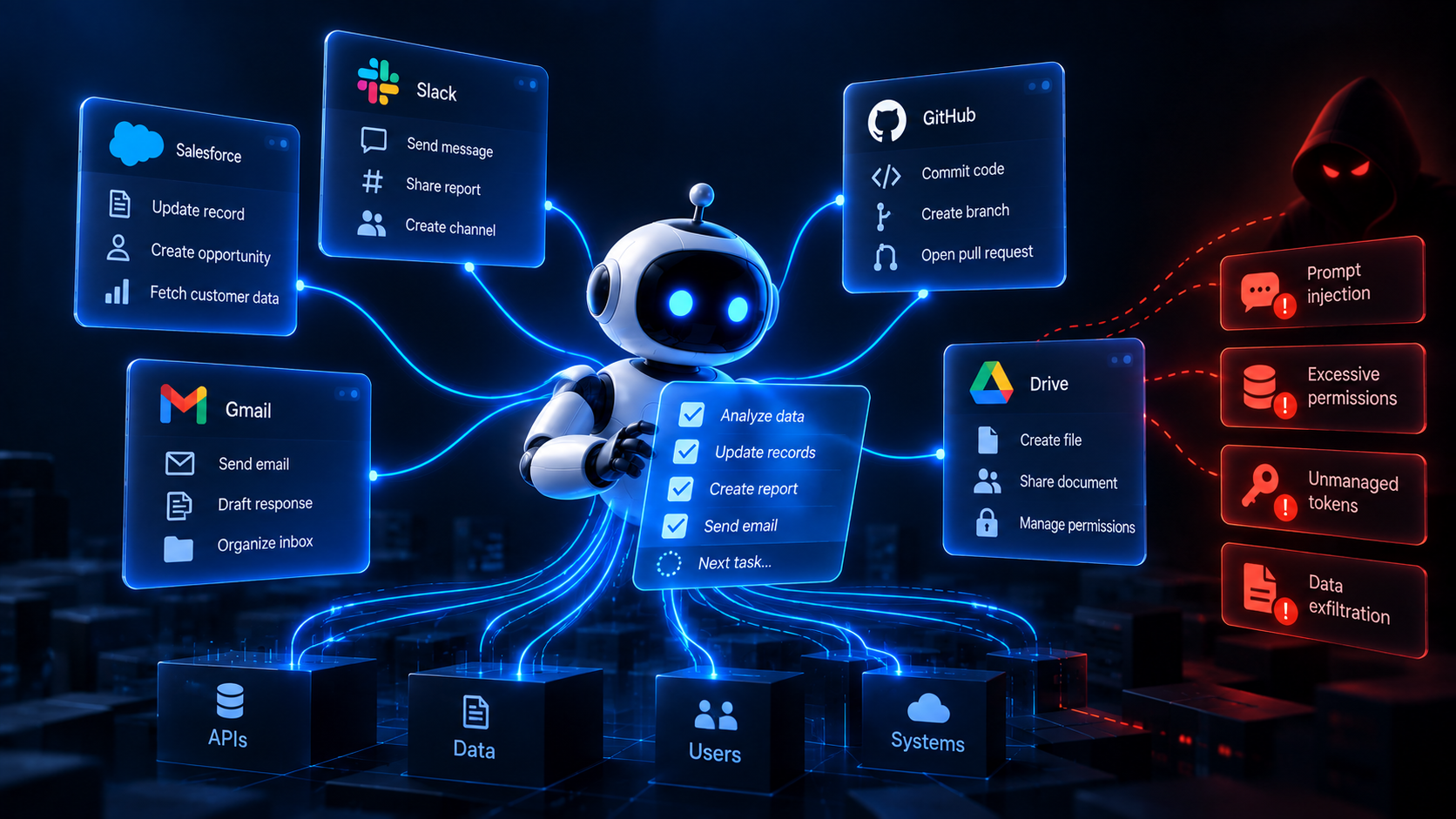
AI agents and other non-human identities can operate continuously, maintain persistent access, connect applications, and execute workflows without the same lifecycle signals organizations traditionally use to govern employees.
As a result, organizations cannot reliably progress from basic AI visibility toward enforcement and continuous control without understanding the identity and access relationships underneath AI activity.
Identity is the control plane that turns AI governance policy into enforceable security decisions.
Frameworks, policies, committees, and acceptable-use standards establish the intent of an AI governance program.
Maturity comes from progressively connecting that intent to operational capabilities:
Visibility → Context → Governance → Enforcement → Continuous Control
Organizations do not need to reach Stage 5 immediately.
A company still building its AI inventory may gain more by improving discovery than by pursuing advanced automation. An organization with strong visibility but weak identity context should prioritize understanding permissions, integrations, and ownership. A company with established policies may need to focus next on enforcement.
The value of a maturity model is knowing both where you are and what capability should come next.
As AI becomes embedded throughout enterprise SaaS, governance will increasingly depend on the ability to continuously connect AI with identity, access, risk, and remediation.
Organizations can use Grip's Shadow AI Assessment to evaluate those capabilities and identify gaps between their current governance model and continuous control.
An AI governance maturity model is a framework organizations can use to assess how effectively they discover AI usage, understand associated risk, establish governance policies, enforce controls, and continuously adapt those controls as AI environments change.
The Grip AI Governance Maturity Model has five stages: Visibility, Context, Governance, Enforcement, and Continuous Control. Organizations progress from discovering where AI exists to continuously monitoring and controlling how AI interacts with identities, applications, permissions, and data.
AI governance maturity can be measured by evaluating operational capabilities across AI discovery, identity and access context, risk classification, policy enforcement, remediation, and continuous monitoring. The key measure is whether governance decisions can be translated into effective controls.
Mature AI governance continuously discovers AI, understands its identity and access relationships, applies risk-based policies, enforces governance decisions, detects changes, and remediates violations. It adapts as AI applications, agents, permissions, integrations, and access relationships change.