Jul 29, 2026
The Hidden Layer of AI Risk: OAuth and Non-Human Identities


Learn how AI agents, OAuth tokens, permissions, and non-human identities create a hidden layer of identity-driven AI risk across SaaS.

Jul 29, 2026
Learn how AI agents, OAuth tokens, permissions, and non-human identities create a hidden layer of identity-driven AI risk across SaaS.
AI security is increasingly an identity and access challenge.
AI applications and agents do not operate in isolation. To perform useful work, they connect to SaaS systems, access enterprise data, call APIs, inherit permissions, and act through OAuth tokens and other credentials. Those relationships create a hidden layer of AI risk beneath the application itself.
Identity-driven AI risk is the security exposure created when AI applications and agents can access, inherit, or act through identities, permissions, tokens, and integrations across enterprise systems.
This matters because an AI application can be approved while the access surrounding it remains excessive, persistent, or poorly understood. Grip Security's 2026 Mid-Year AI Exposure Update illustrates how quickly this identity layer is expanding: organizations now have approximately one AI agent for every 17 identities.
As AI becomes more autonomous, effective governance requires visibility into more than which AI tools are being used. Security teams need to understand who or what can act, what it can access, how it gained that access, and how long the access persists.
A non-human identity in an AI environment is a digital identity used by an AI agent, application, service, API, or automation to authenticate and interact with enterprise systems without direct human action.
These identities can include service accounts, API identities, OAuth-connected applications, automation identities, and increasingly, AI agents.
The distinction matters because AI is accelerating the creation and use of identities capable of acting independently.
Grip's 2026 Mid-Year AI Exposure Update identified a striking pattern across enterprise environments: one AI agent now exists for every 17 identities. This "Rule of 17" signals that AI agents are moving from isolated experiments toward a meaningful part of the enterprise identity landscape.
Unlike a traditional employee account, an AI agent may operate continuously, interact with several applications, and perform actions without a human initiating each step.
That changes the security question. Knowing who has access is no longer enough. Security teams increasingly need to know what has access too.
OAuth is one of the mechanisms that turns an AI application from an isolated tool into an active participant in the enterprise SaaS environment.
The relationship is relatively straightforward:
User or agent → authorization → OAuth token → SaaS access → persistent relationship
A user might authorize an AI application to access email, documents, calendars, CRM records, source code, or another SaaS service. Once authorization is granted, an OAuth token can allow the application to continue interacting with that service according to the permissions it received.
This is useful by design. It is also why OAuth deserves attention in AI security.
Depending on the application and authorization flow, OAuth access can be persistent, cross-system, and broader than the immediate task that prompted the connection. Tokens can remain valid after the user stops actively using the application. Scopes may allow access to substantially more information than the original workflow requires.
AI increases the significance of these relationships because applications are becoming more capable of acting on the access they receive.
OAuth is not simply how an AI application connects. It can determine what that application is capable of doing after the connection is established.
AI agents combine machine identity with increasing autonomy.
A conventional integration typically performs a defined function according to predetermined logic. AI agents can be designed to interpret objectives, make decisions, invoke tools, retrieve information, and take actions across multiple systems.
That can make a single identity significantly more consequential.
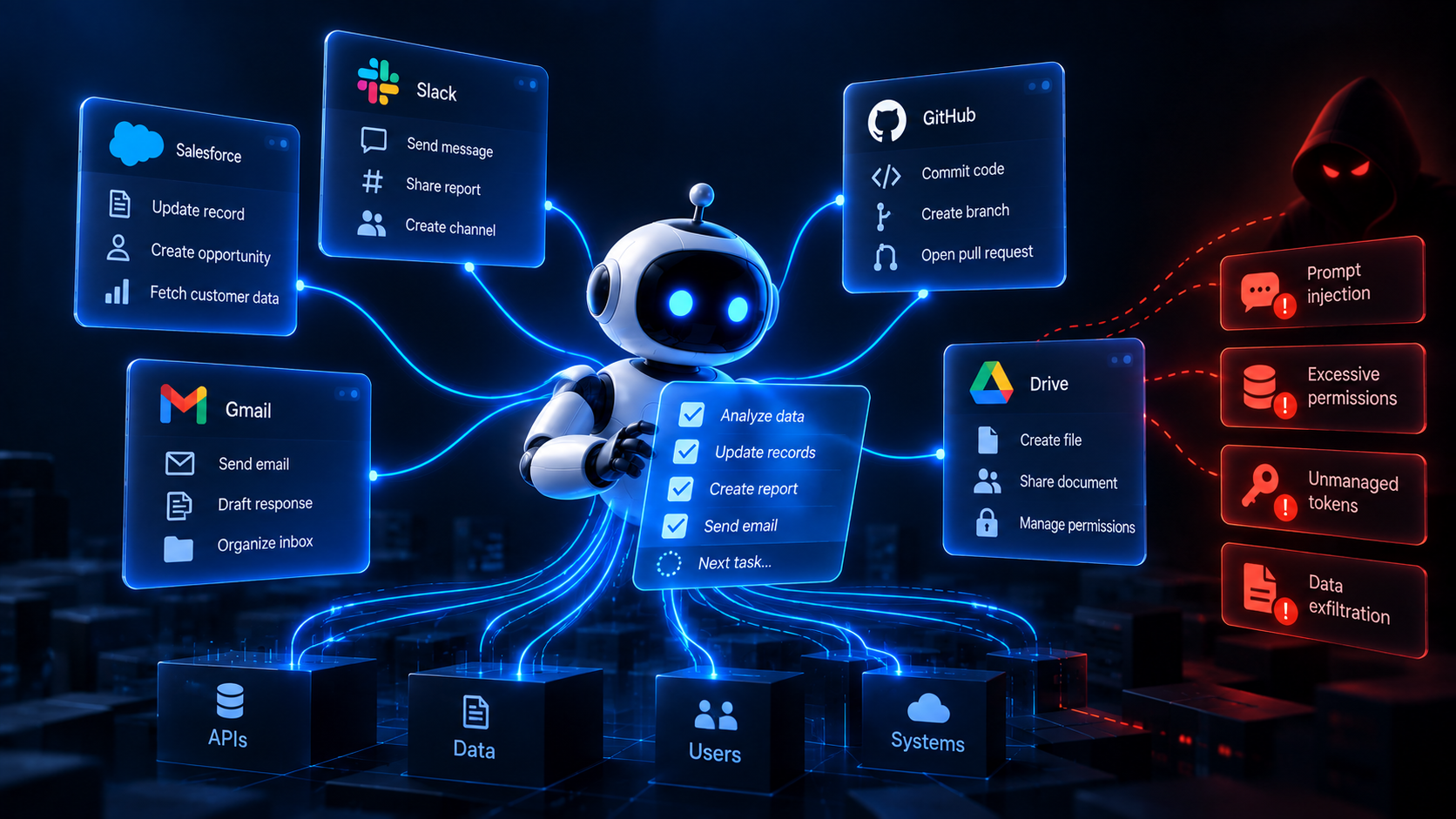
An AI agent might access a document repository, retrieve customer information from a CRM, interact with a ticketing platform, and send information through a communications application. Each action may depend on a different identity, token, permission, or integration.
Agents can also operate continuously. They do not log off at the end of a workday, and their activity may not map neatly to the behavior security teams expect from human users.
The Rule of 17 makes this more than a theoretical architecture concern. If organizations are already seeing approximately one AI agent for every 17 identities, the number of identities capable of autonomous action is becoming material.
And the underlying AI footprint is larger still. Grip's 2026 observations found detectable AI functionality in 54% of enterprise applications.
Together, these trends suggest that security teams are facing two simultaneous changes: AI functionality is spreading throughout SaaS, while AI agents are adding a new population of machine actors to the identity environment.
The security impact of an AI agent depends heavily on the access relationships surrounding it.
An agent with narrow permissions and tightly controlled credentials presents a very different risk profile from an agent connected to several systems through broad, persistent access.
Identity-driven AI risk rarely comes from one permission or token in isolation. It accumulates through relationships.
Consider an AI application that was legitimately approved six months ago. An employee authorized it through OAuth, granting access to several SaaS services. The employee's responsibilities later changed, but the integration remained active. Additional capabilities were added to the application, and its permissions were never revisited.
Nothing in that sequence necessarily requires a malicious application.
Yet the environment may now contain excessive OAuth scopes, long-lived tokens, dormant integrations, orphaned non-human identities, permission drift, and access paths that no longer match the original business purpose.
AI-enabled SaaS makes this harder to track because AI functionality increasingly appears inside applications organizations already use. The security team may know about the SaaS application while having far less visibility into the AI functionality, connected agents, identities, and permissions operating within or around it.
This is why the existence of AI is only part of the risk. The relationships that determine what AI can access and do are often more consequential.
Many AI governance programs begin with reasonable questions:
Which AI vendors are approved?
Which models can employees use?
What data can employees submit?
What policies govern AI usage?
Those controls matter, but they provide an incomplete picture when AI can act through existing enterprise identities and access relationships.
An approved AI vendor can still have an overprivileged OAuth grant. An authorized agent can still possess a long-lived token. A sanctioned SaaS application can still introduce new AI capabilities or integrations. A legitimate automation can retain access after its owner or business purpose changes.
Governance therefore needs to extend from application approval into access governance.
Security teams need visibility into the identities associated with AI, the permissions those identities possess, the SaaS systems they can reach, and the credentials that keep those relationships active.
Without that foundation, organizations can govern which AI applications are permitted while remaining unclear about what those applications can actually do.
AI governance without identity visibility governs the front door while leaving the access paths behind it poorly understood.
Securing this layer starts with treating AI access as part of the broader enterprise identity environment rather than as a separate AI inventory.
Security teams should focus on several practical controls:
The objective is not to restrict every AI integration. It is to establish continuous knowledge of the identities and access relationships that allow AI to operate.
This creates a practical progression for AI security:
AI Risk → Identity → Governance → Continuous Control
As AI becomes more autonomous, AI security increasingly depends on identity security.
The important questions are no longer limited to which AI applications an organization uses. Security teams also need to know who or what can act, what it can access, how that access was granted, and how long it can persist.
AI agents, OAuth grants, tokens, service accounts, APIs, and SaaS integrations form an identity layer beneath the visible AI application. That layer determines how AI interacts with enterprise systems and how far its access can extend.
Organizations that can continuously discover these relationships, evaluate their permissions, and remediate unnecessary access will be better positioned to govern AI as its capabilities expand.
Because as AI gains the ability to act, identity becomes the control plane for AI risk.
A non-human identity in AI is a digital identity used by an AI agent, application, service, API, or automation to authenticate and interact with enterprise systems without requiring a human to perform each action.
Yes. AI agents can function as non-human identities when they authenticate to systems, use credentials or tokens, access resources, and perform actions independently of a human user. Their increasing autonomy makes their permissions and access especially important to manage.
OAuth can grant AI applications and agents persistent access to SaaS data and functionality. Risk can arise when OAuth scopes are excessive, tokens remain active too long, integrations become dormant, or permissions continue after the original business need has changed.
Organizations should discover AI-related NHIs, inventory OAuth connections, map identities to permissions, enforce least privilege, manage token lifecycles, continuously review access, and revoke stale or unnecessary identities, integrations, and permissions.