Sep 2, 2026
OAuth Token Risk: Why Long-Lived Access Is a SaaS Security Blind Spot


Long-lived OAuth tokens create persistent SaaS access attackers exploit. Learn why OAuth is a blind spot and how to reduce token risk.

Sep 2, 2026
Long-lived OAuth tokens create persistent SaaS access attackers exploit. Learn why OAuth is a blind spot and how to reduce token risk.
OAuth tokens have become the foundational currency of modern enterprise SaaS connectivity, enabling seamless integrations across cloud platforms, productivity suites, and developer tools. However, while enterprise security programs heavily invest in protecting human login interfaces through Multi-Factor Authentication (MFA) and Single Sign-On (SSO), OAuth tokens operate almost entirely behind the scenes as long-lived, machine-to-machine credentials that bypass traditional perimeter defenses.
These persistent authorization grants represent a major category of non-human identities (NHIs). Because OAuth refresh tokens can persist indefinitely without expiring, a single compromised integration token can expose sensitive data across connected SaaS environments for months or years. The risks have escalated further with the proliferation of shadow AI and autonomous agents requesting broad third-party API permissions.
Eliminating OAuth blind spots requires integrating token governance into broader identity and AI security strategies. Security teams must continuously discover all active grants, audit excessive read-write scopes, enforce automated revocation on inactive tokens, and actively monitor cross-SaaS API interactions for signs of unauthorized lateral movement.
In late 2025, attackers infiltrated Salesloft's GitHub repositories and Drift's AWS environment, extracting OAuth tokens tied to customer integrations. Those tokens unlocked sensitive data across connected Salesforce environments — account metadata, AWS credentials, Snowflake tokens, and internal notes. The blast radius reached more than 700 organizations through a single compromised third-party integration. As Obsidian Security noted: "The biggest SaaS breach of 2025 started with a compromised third-party app."
This wasn't a zero-day or a sophisticated malware campaign. It was the quiet weaponization of OAuth — the same token-based trust model your organization uses every day to connect SaaS apps, automate workflows, and grant third-party tools access to your data. The Salesloft-Drift breach exposed a fundamental truth: OAuth tokens are the soft underbelly of modern SaaS security, and most security teams have almost no visibility into them.
If you're a CISO or security engineer, you likely have hundreds — possibly thousands — of active OAuth grants across your SaaS estate right now. Many were created by employees who no longer work at your company. Many grant scopes that far exceed what the integration actually needs. And most will remain valid for months or years unless someone manually revokes them. This is your SaaS security blind spot, and it's getting worse as AI agents multiply the number of non-human identities requesting OAuth access.
OAuth 2.0 was designed to solve a real problem: how do you let one application access data in another without sharing passwords? The answer is delegation. A user authorizes a scoped access token that grants a third-party app specific permissions for a limited time. It's elegant in theory. In practice, the implementation creates significant security gaps.
A typical OAuth flow in SaaS works like this: a user clicks "Allow" on a consent screen, the authorization server issues an access token (and often a refresh token), the app presents that token to the resource server to access data, and the token is stored and reused — often indefinitely, without further user interaction.
The risk lives in that last step. While access tokens are supposed to be short-lived, refresh tokens can persist for months or even years. Many SaaS providers set generous token lifetimes by default, and some tokens never expire unless manually revoked. An OAuth grant created by an employee six months ago — for an app they may have stopped using — can still provide full access to your organization's data today.
The problem compounds across three dimensions:
• Over-privileged scopes: Most consent screens offer all-or-nothing scope bundles. An app that needs read-only calendar access often gets full calendar management, contacts, and email. Users rarely audit these scopes.
• Orphaned tokens: When an employee leaves, their SSO session is terminated — but their OAuth tokens may not be. Tokens issued to third-party apps persist independently of the user's session. The app retains access even after the user is gone.
• Transitive trust: An OAuth token grants access not just to one app's data, but potentially to connected integrations downstream. A CRM integration token can become a gateway to email, document storage, and collaboration platforms.
As Grip's own research states: "OAuth's token-based trust model is being weaponized to create persistent access that is extremely difficult to detect and remediate."
The Salesloft-Drift breach is the clearest illustration of how OAuth token theft turns a single compromise into a supply-chain catastrophe. Based on analysis from Group-IB and other threat researchers:
Attackers first gained access to Salesloft's GitHub repositories and Drift's AWS environment. From there, they extracted OAuth tokens tied to customer integrations — the tokens Salesloft and Drift used to connect to their customers' Salesforce and Google Workspace instances. With those stolen tokens, attackers accessed connected Salesforce environments and extracted account metadata, AWS credentials, Snowflake tokens, and internal notes.
The blast radius was staggering. According to Josys, the attack exposed more than 700 organizations — all through stolen tokens from a single trusted third-party integration. Obsidian Security estimated the blast radius was ~10x greater than prior incidents that directly infiltrated Salesforce. When you compromise a platform that integrates with hundreds of customers, you get a force multiplier that direct attacks can't match.
The threat actor group, tracked as UNC6395, didn't stop at stealing existing tokens. According to Group-IB, they also created new OAuth applications designed to blend into the normal environment — rogue apps that looked legitimate, making detection even harder.
AppOmni's analysis connects this to a broader pattern. UNC6395 abused the Drift-Salesforce integration trust, while a separate group, UNC6040, leveraged a rogue Salesforce Data Loader app. Both illustrate the same vulnerability: attackers are exploiting the web of trust between SaaS platforms, and OAuth tokens are the connective tissue. For a deeper look, see our analysis of SaaS integrations as a supply chain attack surface.
Despite the clear and demonstrated risk, most security teams have minimal visibility into their OAuth token landscape. The blind spots fall into several categories:
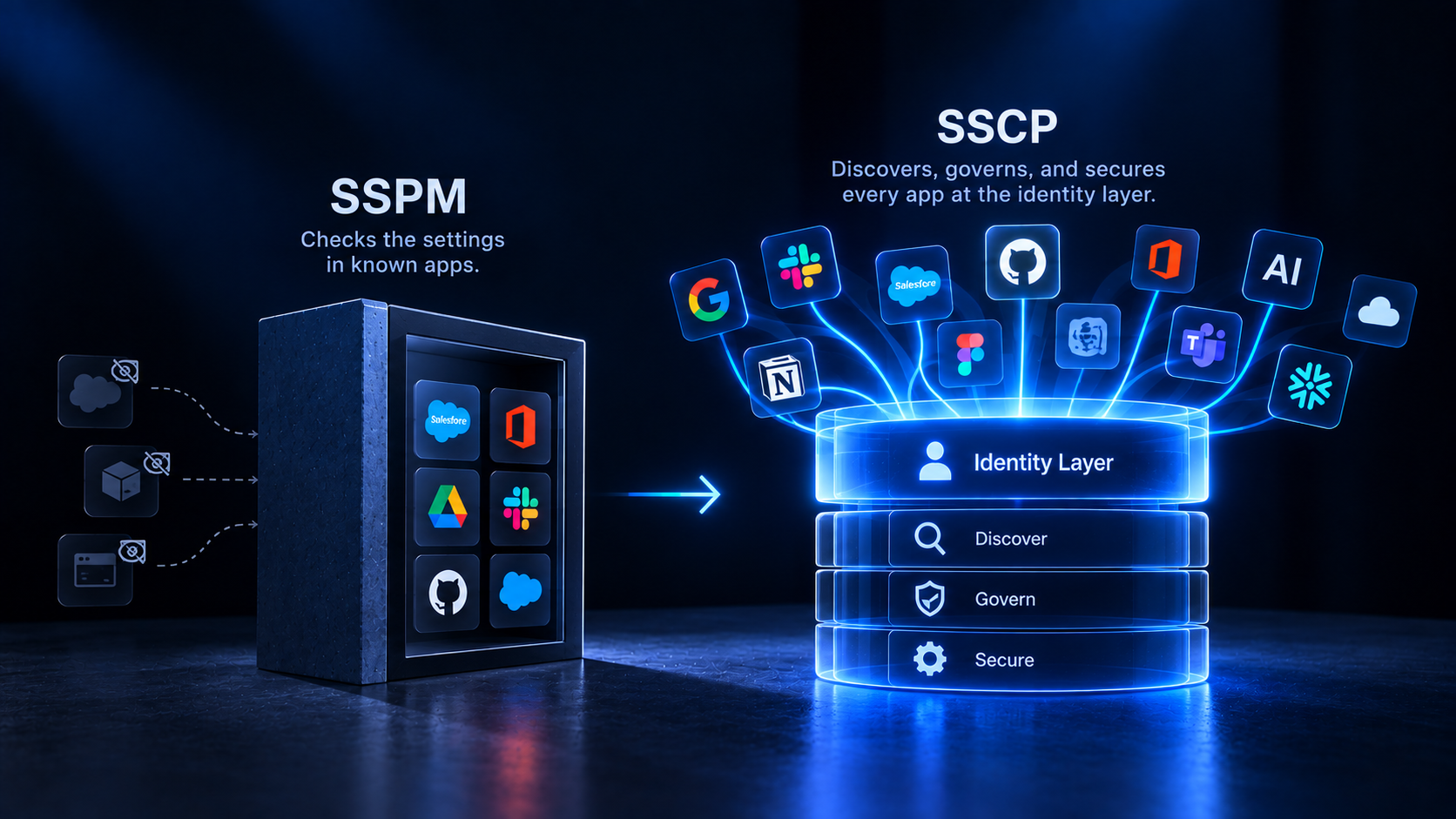
No inventory of active grants. Your identity provider tracks human users and SSO sessions. Your SaaS Security Posture Management tool may scan for misconfigurations. But neither typically provides a comprehensive view of which third-party apps hold active OAuth tokens, what scopes they grant, and when they expire. OAuth grants live in each SaaS platform's admin console — Google Workspace, Salesforce, Slack, Microsoft 365 — with no unified view across the estate.
Shadow SaaS amplifies the problem. Employees connect third-party apps to corporate SaaS accounts without IT oversight, creating shadow SaaS OAuth grants no one knows about. Each grant creates a new access path that bypasses your security controls entirely.
Tokens outlive their owners. When an employee departs, your offboarding process likely revokes SSO access and deactivates accounts. But OAuth tokens issued to third-party apps on that employee's behalf often persist independently. The M-Trends 2026 Report from Google Cloud confirms this: "Because these often remain valid post-logout, attackers can hijack sessions without triggering MFA alerts."
Refresh tokens are the real danger. Security teams often focus on access tokens, which are typically short-lived. But refresh tokens can last for months or years and generate new access tokens on demand. An attacker who steals a refresh token has persistent access that survives token rotation, password changes, and even MFA re-enrollment. The UNC6395 group's stolen tokens remained valid for months and could have persisted indefinitely without manual revocation.
The OAuth token problem is about to get dramatically worse. The rise of AI agents — autonomous software entities that act on behalf of human users — is creating an explosion of new non-human identities, each needing OAuth access to SaaS platforms.
According to miniOrange's 2026 research, organizations already manage an average of 3-5x more machine identities than human users. That ratio is accelerating as AI agents proliferate. Grip's own Rule of 17 research found that organizations now average approximately 1 AI agent per 17 identities — and that number is growing rapidly.
Here's why AI agents make OAuth risk exponentially worse:
• Volume: Every AI agent connecting to a SaaS platform needs an OAuth token. At 1,000 human identities and 1 agent per 17 identities, that's ~59 agents with their own grants. Scale to 10,000 employees and you're looking at ~588 agents with potentially thousands of active tokens.
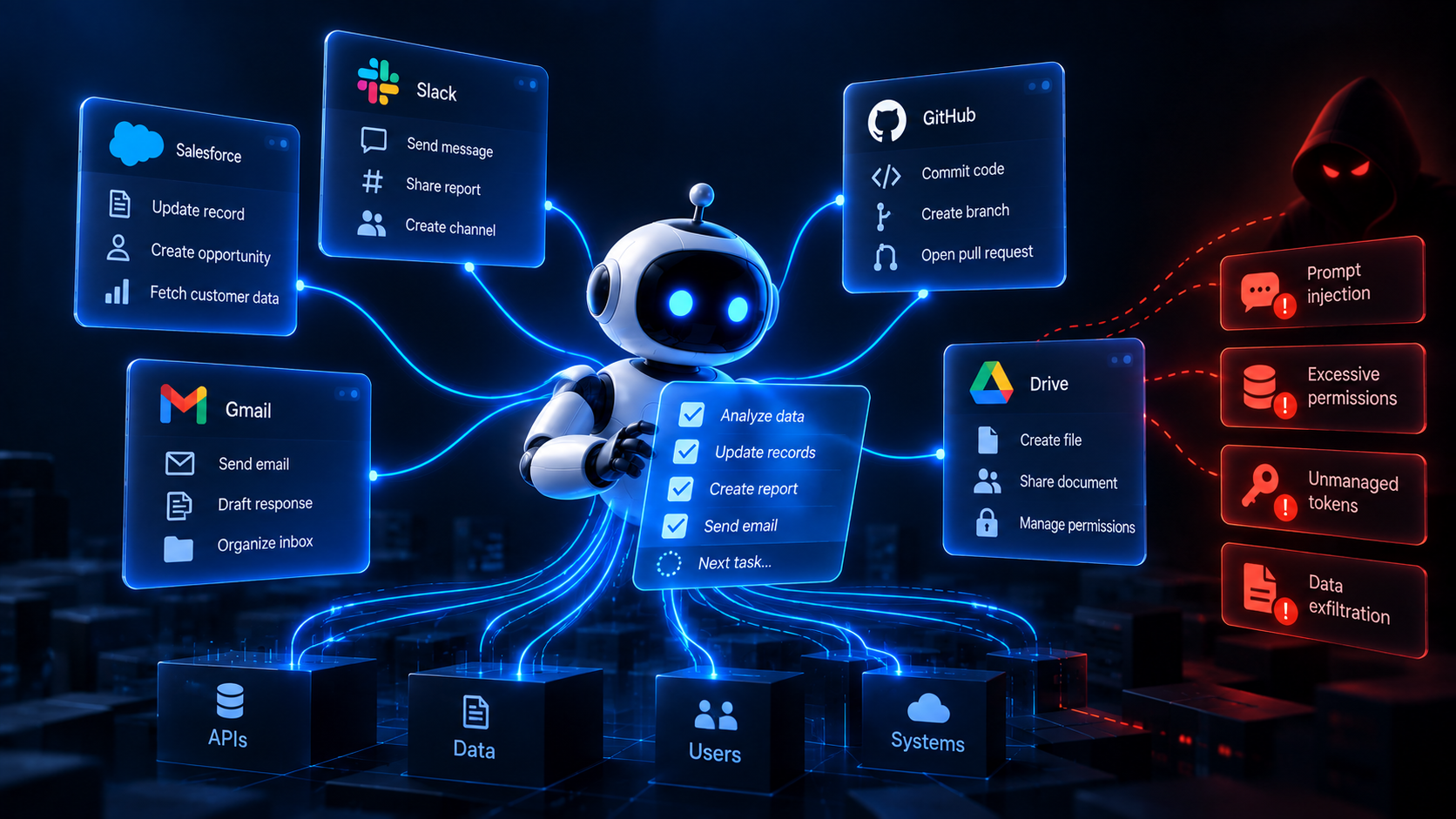
• Over-privileged access: AI agents often request broad scopes to perform complex tasks. An agent analyzing sales data might request full CRM read/write when it only needs read access to specific objects. These grants are harder to detect because agent usage patterns are less predictable than human ones.
• Persistent access by design: AI agents operate continuously — they don't log in and out. Their OAuth tokens are configured for long lifetimes by default, creating exactly the persistent access attackers exploit.
• Inherited permissions: When an AI agent acts on behalf of a human user, it inherits that user's permissions. A high-privilege user's agent can access everything the user can — and the OAuth token encoding that access persists even when the agent isn't running.
This is the core of the AI-native security challenge: AI risk is fundamentally identity risk. Agents act through identities, access data through OAuth grants, and inherit permissions from human users. The attack surface isn't a new category of AI-specific threats — it's the same identity infrastructure you already have, multiplied by orders of magnitude and operating at machine speed. For a comprehensive framework, see our AI agent security guide for CISOs.
You can't eliminate OAuth token risk entirely — OAuth is foundational to modern SaaS. But you can dramatically reduce exposure with a structured approach to token governance:
1. Inventory every active OAuth grant. Start with your highest-risk platforms — Google Workspace, Microsoft 365, Salesforce, Slack — and enumerate every third-party app with an active token. Document app name, authorized user, scopes, creation date, and last access. This is your baseline. Without it, you're operating blind.
2. Revoke orphaned and unused tokens. Cross-reference your OAuth inventory against your HR system. Revoke any token authorized by a former employee. Revoke tokens for apps that haven't accessed data in 90+ days and re-authorize only if there's a legitimate business need.
3. Enforce least-privilege scopes. Review every active grant and ask whether the app needs its current scopes. Push app owners toward granular scopes. For apps that only offer broad bundles, document the risk and set a review cadence.
4. Implement token lifecycle management. Set maximum token lifetimes where platforms allow. Configure automated revocation tied to your identity lifecycle — when a user is offboarded, their OAuth tokens should be revoked across all SaaS platforms, not just their SSO session.
5. Monitor for anomalous token usage. Establish baselines for normal OAuth activity. Alert on deviations: tokens accessing new resources, usage from unexpected locations, or new OAuth apps appearing without an authorization record.
6. Treat AI agent tokens as a distinct risk class. Don't let agent OAuth grants blend into your general inventory. Tag them, monitor separately, and apply stricter lifecycle policies. AI agents operate at machine speed — a compromised agent token can exfiltrate data far faster than a human one. For a framework on scaling this, see our guide on managing non-human identities at scale.
7. Audit third-party integration trust chains. The Salesloft-Drift breach proved your risk extends to tokens held by integration partners. Map critical SaaS integrations, assess what data each partner can access through OAuth, and demand transparency about their token security practices.
Grip Security approaches OAuth token risk as what it fundamentally is: an identity problem. Our platform is built on the principle that every OAuth token is a non-human identity that must be discovered, governed, and monitored throughout its lifecycle.
• Continuous OAuth discovery: Grip automatically discovers all active OAuth grants across your SaaS estate — including shadow SaaS grants created without IT oversight. You get a unified inventory of every token, its scopes, the authorizing user, and its current status across all major platforms.
• Identity lifecycle correlation: Grip correlates OAuth tokens to your identity lifecycle. When a user is offboarded, Grip identifies all tokens authorized by that user and flags them for revocation — closing the gap that lets orphaned tokens persist.
• Scope and privilege analysis: Grip analyzes every grant for over-privileged scopes, comparing requested scopes against actual usage. Over-privileged tokens are flagged for remediation, enforcing least-privilege without manual audits.
• AI agent identity governance: Grip treats agent OAuth tokens as a distinct identity class — discovered, tagged, and monitored with policies tailored to machine-speed access patterns. This is critical as the Rule of 17 ratio accelerates.
• Anomaly detection and automated remediation: Grip monitors token usage in real time, alerting on anomalies — new apps, unexpected scope usage, geographic deviations. Risky tokens can be automatically revoked based on policy, without manual intervention.
This identity-first approach is why 95.5% of Grip customers prevented multiple AI and SaaS breaches in 2025. With 125 million users protected and 7 patents in identity-driven SaaS security, Grip's platform is purpose-built for the era where AI agents, OAuth tokens, and SaaS sprawl converge into a single, identity-centric attack surface.
The Salesloft-Drift breach showed what happens when OAuth token risk goes unmanaged. The AI agent era is multiplying that risk at machine speed. The organizations that treat OAuth tokens as identities — not just API credentials — will be the ones that survive the convergence.
An OAuth token is an access credential that allows a third-party application to access data on a user's behalf. It becomes a security risk when tokens are long-lived, over-privileged, or orphaned — persisting after the authorizing user leaves. Attackers can steal these tokens to gain persistent SaaS access without triggering MFA alerts.
Access tokens are usually short-lived (minutes to hours), but refresh tokens can persist for months or years — and in some platforms, they never expire unless manually revoked. The M-Trends 2026 Report confirmed these tokens often remain valid even after logout, enabling session hijacking without MFA.
In late 2025, attackers compromised Salesloft's GitHub and Drift's AWS, extracting OAuth tokens tied to customer integrations. Those tokens provided access to Salesforce and Google Workspace across more than 700 organizations. The blast radius was ~10x greater than prior direct Salesforce breaches because the attack leveraged the trust chain between integration providers and their customers.
AI agents require OAuth tokens to access SaaS platforms, and they're proliferating rapidly — Grip's Rule of 17 research found approximately 1 AI agent per 17 identities. Each agent token is a non-human identity with inherited permissions, persistent access by design, and often over-privileged scopes, multiplying the attack surface at machine speed.
Inventory every active OAuth grant, revoke tokens for departed employees and unused apps, enforce least-privilege scopes, implement token lifecycle management tied to your identity lifecycle, monitor for anomalous usage, and treat AI agent tokens as a distinct risk class. An identity-driven SaaS security platform like Grip can automate much of this.
• M-Trends 2026 Report — Google Cloud. Attackers harvest long-lived OAuth tokens and session cookies that remain valid post-logout, enabling session hijacking without MFA alerts.
• miniOrange (2026) — Organizations manage an average of 3-5x more machine identities than human users, driving SaaS sprawl and fragmented access controls.
• Grip Security Research — "OAuth's token-based trust model is being weaponized to create persistent access that is extremely difficult to detect and remediate."
• Salesloft-Drift Breach Analysis (late 2025) — Attackers harvested OAuth tokens from an integration provider, compromising 700+ organizations. Blast radius ~10x greater than prior direct Salesforce incidents.
• Obsidian Security — "The biggest SaaS breach of 2025 started with a compromised third-party app."
• UNC6395 Threat Actor Group — Stole OAuth tokens for SaaS-to-SaaS compromise across Salesforce, Google Workspace, and other platforms. Tokens remained valid for months unless manually revoked.
• Josys (2026) — The 2025 Salesloft-Drift OAuth supply-chain attack exposed more than 700 organizations via stolen tokens from a single trusted third-party integration.
• Group-IB — Attackers accessed Salesloft's GitHub and Drift's AWS, extracting OAuth tokens that unlocked Salesforce data, AWS credentials, Snowflake tokens, and internal notes. Attackers also created rogue OAuth applications to blend into target environments.
• AppOmni — UNC6395 (abused Drift-Salesforce integration) and UNC6040 (rogue Salesforce Data Loader app) highlight attackers abusing the web of trust between SaaS platforms.
• Grip Security — Rule of 17 research (1 AI agent per 17 identities); 125M users protected; 7 patents in identity-driven SaaS security; 95.5% of customers prevented multiple AI + SaaS breaches in 2025.
AI Security & Shadow AI

SaaS Security & SSPM