Sep 22, 2026
CASB vs. SSPM: Why Network Proxies Miss SaaS Breaches


An architectural breakdown comparing CASB, legacy SSPM, and ITDR: why network inspection fails at SaaS token theft and how identity security solves it.

Grip Security

Sep 22, 2026
An architectural breakdown comparing CASB, legacy SSPM, and ITDR: why network inspection fails at SaaS token theft and how identity security solves it.
Enterprise cybersecurity strategies are experiencing a fundamental inflection point. For over a decade, security leaders relied on Cloud Access Security Brokers (CASBs) to govern cloud usage through network proxies. Later, first-generation SaaS Security Posture Management (SSPM) tools emerged to scan configuration settings in major SaaS platforms. Yet, despite massive investments in both categories, SaaS-driven breaches continue to surge at unprecedented rates.
The root problem is architectural: modern SaaS risk is no longer a network perimeter issue, nor is it merely a static configuration checklist. SaaS risk has fundamentally transformed into an identity, OAuth supply chain, and non-human access problem. This guide analyzes the structural differences between CASB, legacy SSPM, and Identity Threat Detection and Response (ITDR), demonstrating why network inspection fails against token theft and why an identity-first SaaS Security Control Plane is essential for modern enterprise defense.
• The Network Proxy Blind Spot: CASBs inspect traffic traversing network gateways, but over 85% of modern SaaS data exchange occurs via cloud-to-cloud OAuth grants, REST APIs, and background integrations that bypass corporate networks entirely.
• The Configuration Fallacy: Legacy SSPM tools audit admin toggles in a handful of sanctioned suites, leaving the vast long-tail of SaaS applications, browser plugins, and shadow AI workflows completely unmonitored.
• The Token Hijacking Threat Vector: Adversaries increasingly bypass Multi-Factor Authentication (MFA) by stealing session cookies and OAuth access tokens, rendering static posture scores meaningless without continuous identity behavior monitoring.
• The Control Plane Convergence: Modern enterprise defense requires converging posture hardening, shadow discovery, and continuous ITDR into a single identity-first control plane.
To architect an effective SaaS defense, security leaders must clearly delineate the capabilities, operational models, and architectural boundaries of these three distinct security categories.
Introduced in the early 2010s, CASBs were designed to sit between on-premises users and cloud service providers. Deployed primarily as inline proxies (forward or reverse) or via retroactive API connectors, CASBs enforce access policies, monitor high-level cloud usage, and apply Data Loss Prevention (DLP) rules to file uploads and downloads.
SSPM tools emerged to automate the auditing of application configurations. Instead of intercepting network packets, SSPMs connect directly to SaaS administrative APIs. They evaluate settings against security benchmarks (such as CIS Controls or NIST 800-53), alerting security teams to misconfigurations such as publicly accessible Salesforce repositories, disabled MFA, or permissive file-sharing settings in Google Workspace.
Identity Threat Detection and Response (ITDR) represents the newest category, focusing specifically on protecting identity infrastructure and credential integrity. ITDR monitors authentication flows, user permissions, machine identities, and credential usage patterns to detect credential stuffing, impossible travel, privilege escalation, and active session hijacking across hybrid environments.
While CASBs served an important purpose during the initial migration from on-premise data centers to cloud software, their reliance on network routing creates catastrophic blind spots in modern work environments:
When an employee connects a third-party generative AI tool or productivity plugin to Microsoft 365, the authorization occurs directly via cloud-to-cloud OAuth protocols. Data flows directly between the two SaaS vendors' cloud infrastructures. Because no network packet ever traverses the corporate firewall, VPN, or CASB proxy gateway, the proxy possesses zero visibility into the integration or subsequent data transfers.
Modern distributed workforces routinely access SaaS applications from personal mobile phones, contractor laptops, and home networks without routing traffic through corporate proxy agents. Forcing all global traffic through inline inspection proxies introduces severe latency and degrades application performance, driving users to disable proxy clients.
Employees continuously discover and adopt new specialized AI assistants and autonomous workflows. Traditional CASBs rely on static URL databases to block or categorize domains. In contrast, Shadow AI adoption occurs dynamically: users paste proprietary data into emerging LLM interfaces weeks before legacy proxy vendors categorize the domains.
Looking beyond legacy proxies? Discover how Grip's identity-first architecture provides continuous visibility into shadow SaaS, OAuth tokens, and active credential threats. Book a Demo →
First-generation SSPM tools addressed configuration oversight, but their technical design limits their utility as a primary security solution:
• API Connector Dependency: Legacy SSPMs require security teams to manually provision API administrative tokens for every single application. Consequently, enterprise coverage rarely exceeds 15 - 20 sanctioned applications. The average enterprise utilizes thousands of SaaS applications, leaving the vast majority of SaaS software uninspected.
• Alert Fatigue and Ticket Generation: Early posture tools overwhelm SecOps teams with thousands of low-context configuration alerts without context on whether an account is actively exploited or even assigned to an active employee.
• Zero Non-Human Identity Governance: Traditional scanners audit human user accounts but fail to govern the sprawling ecosystem of service accounts, API keys, and machine-to-machine integrations that comprise the modern non-human identity management challenge.
• Blindness to Active Threats: An application may be 100% compliant with CIS benchmarks, yet actively compromised via stolen session cookies or a malicious OAuth application. Posture auditing alone cannot detect active account takeovers.
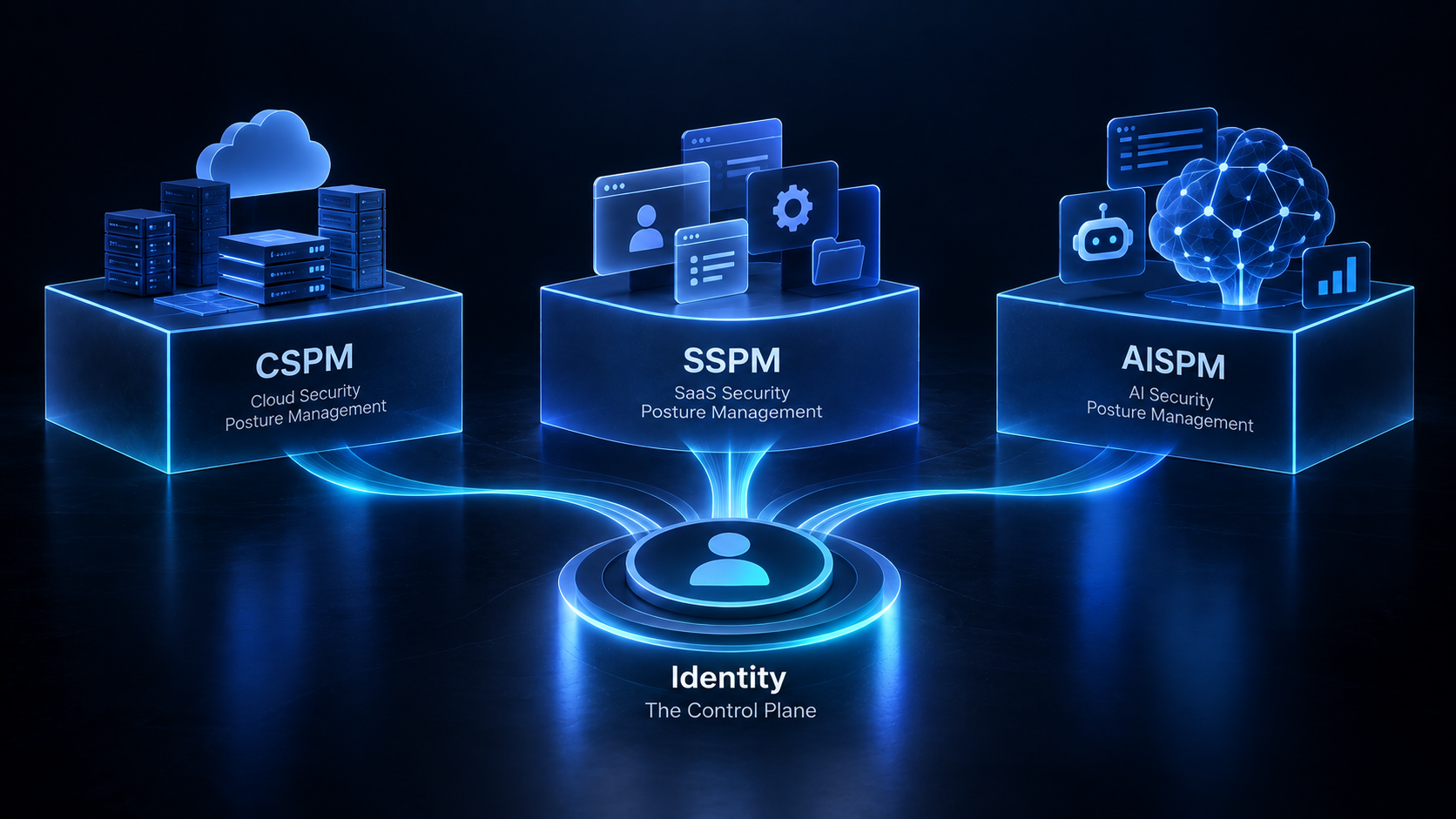
To eliminate these systemic blind spots, leading organizations are deploying an Identity-First SaaS Security Control Plane. Rather than inspecting network packets or relying exclusively on isolated API connectors, an identity-centric control plane anchors security directly to human and machine authentication events.
This modern architecture provides three unified capabilities:
1. Universal Shadow SaaS & AI Discovery: Automatically discovering every SaaS application, AI tool, and browser extension accessed across the enterprise without requiring proxies or manual API configuration.
2. Continuous OAuth & Token Governance: Continuously mapping and auditing the OAuth supply chain to identify over-privileged scopes, dormant machine integrations, and malicious app-to-app permissions.
3. Identity Threat Detection & Automated Remediation: Real-time detection of credential abuse, session hijacking, and offboarding access gaps, paired with automated one-click workflows to revoke tokens and isolate compromised identities.
While legacy CASBs and SSPMs address different layers, an identity-first SaaS control plane effectively subsumes the cloud visibility and governance functions of a CASB without requiring complex network proxies or endpoint agents.
SaaS applications are natively exposed to the public internet. By stealing valid session cookies or obtaining persistent OAuth tokens, attackers bypass firewalls, VPNs, and MFA controls entirely, impersonating legitimate users without needing to exploit complex software vulnerabilities.
Legacy SSPMs rely strictly on API connectors to scan configuration checklists across a small number of sanctioned enterprise apps. An identity-first control plane secures both sanctioned and unsanctioned applications across the entire SaaS estate by governing human and non-human identities directly.
No. Modern identity-first architectures integrate directly with existing identity providers, enterprise email gateways, and authentication fabrics, providing full visibility and control across managed and unmanaged applications in minutes without requiring endpoint agents or network proxies.
By monitoring identity relationships and OAuth authorization exchanges, an identity-first control plane identifies when employees or automated scripts connect third-party AI platforms to corporate systems, mapping the exact data access scopes granted and enforcing real-time governance.
Stop relying on outdated network proxies that miss SaaS breaches and token theft. Discover how Grip's AI Security and identity-first control plane unify posture management, shadow discovery, and active threat response. Book a Demo today.