Sep 22, 2026
CASB vs. SSPM vs. ITDR: Architectural Comparison


Why legacy network proxies miss 85%+ of modern SaaS risk, and how identity-first posture management closes the OAuth and token security gap.

Grip Security

Sep 22, 2026
Why legacy network proxies miss 85%+ of modern SaaS risk, and how identity-first posture management closes the OAuth and token security gap.
Enterprise cybersecurity strategies are experiencing a fundamental inflection point. For over a decade, security leaders relied on Cloud Access Security Brokers (CASBs) as the primary control point for software-as-a-service (SaaS) usage. However, the modern enterprise SaaS landscape—defined by decentralized business-led adoption, cross-cloud OAuth integrations, unmanaged non-human identities, and autonomous AI agents—has rendered traditional network-perimeter approaches structurally inadequate.
Today, over 85% of an organization's SaaS footprint operates beyond the reach of corporate networks, and the vast majority of SaaS security breaches stem from compromised credentials and excessive OAuth grants rather than network-level data exfiltration. To protect corporate data and maintain regulatory compliance, enterprise security architectures must evolve from passive network proxies to proactive, identity-centric SaaS Security Posture Management (SSPM) and Identity Threat Detection and Response (ITDR).
As the cloud attack surface has diversified, three distinct disciplines have emerged to address SaaS risk. Understanding their architectural foundations is critical for security leaders designing an effective defense:
Introduced in the early 2010s, a Cloud Access Security Broker (CASB) sits between on-premises users and cloud applications. Its primary function is to enforce security, compliance, and governance policies across cloud traffic via forward proxies, reverse proxies, and API connectors.
Primary Strengths: Data Loss Prevention (DLP) for sanctioned suites, inline malware filtering, and monitoring traffic routed through corporate VPNs or secure web gateways (SWGs).
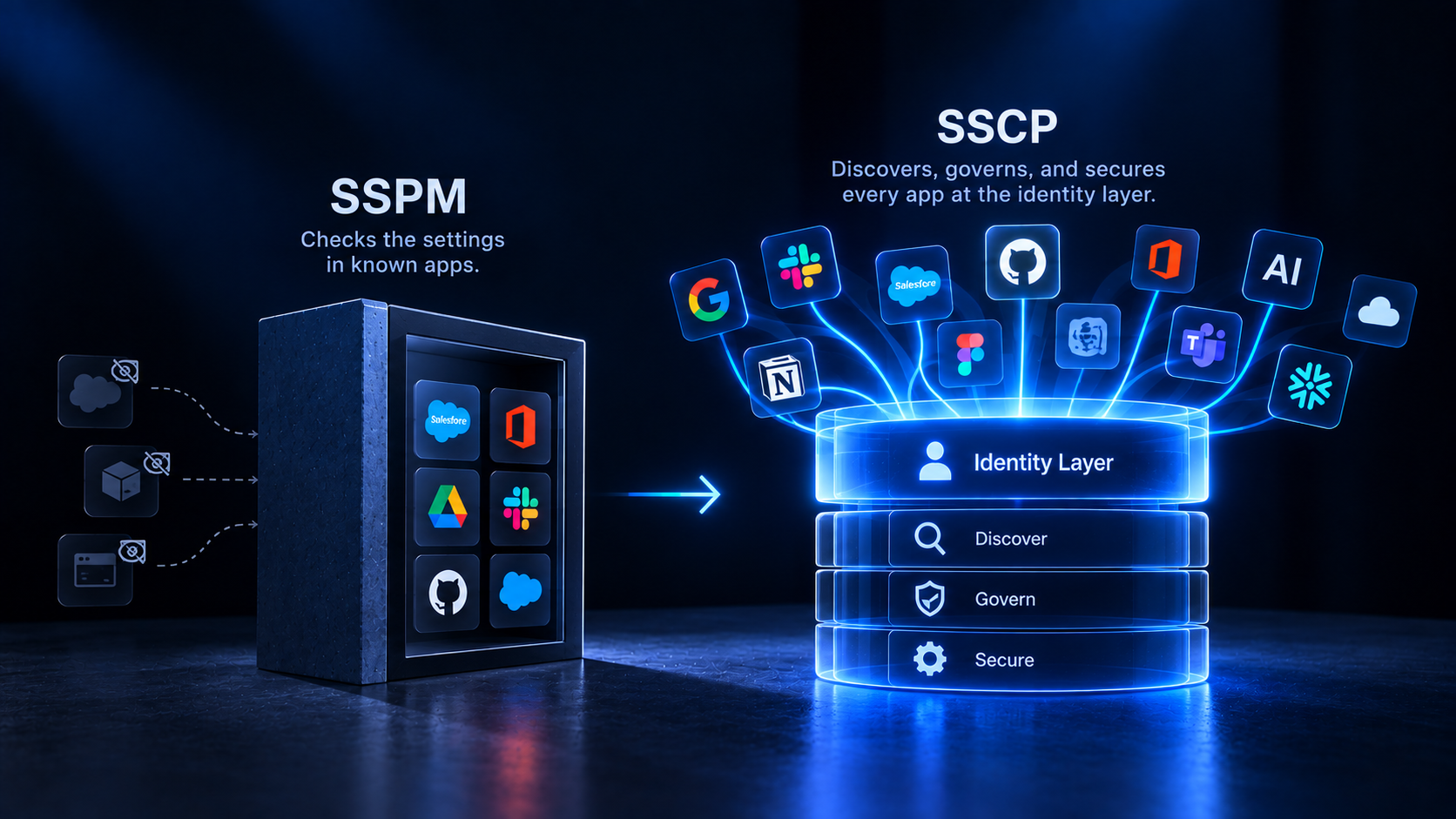
A SaaS Security Posture Management (SSPM) solution continuously monitors, audits, and remediates security misconfigurations, privilege creep, and compliance drift within SaaS applications. Rather than monitoring network traffic, SSPM interfaces directly with SaaS metadata, administrative consoles, and identity providers.
Primary Strengths: Deep in-app configuration auditing, administrative entitlement management, continuous compliance monitoring (SOC 2, ISO 27001, HIPAA), and visibility into third-party OAuth app ecosystems.
Identity Threat Detection and Response (ITDR) focuses on detecting and neutralizing active identity-based attacks. In SaaS environments, ITDR monitors authentication anomalies, credential stuffing, session hijacking, unauthorized OAuth grants, and token theft across both human and non-human identities.
Primary Strengths: Real-time behavioral telemetry, automated credential rotation, instant session revocation, and unmanaged app visibility.
The structural difference between CASB, legacy SSPM, and modern identity-first control planes determines what risks security teams can actually see and control:
| Capability / Architectural Vector | Legacy CASB (Proxy-Based) | Traditional SSPM (API-Only) | Identity-First SaaS Control Plane |
|---|---|---|---|
| Shadow SaaS Discovery | Partial (requires traffic through corporate proxy/VPN) | None (limited to pre-configured API connectors) | Complete (discovers 100% of human & non-human app usage) |
| Off-Network & BYOD Coverage | Blind unless traffic is forced through an agent or proxy | Full visibility into connected APIs | Continuous protection across all devices and direct cloud logins |
| Cloud-to-Cloud OAuth Inspection | Completely Blind (zero network traffic generated) | Scans app marketplaces for connected suites | Continuous mapping of scopes, tokens, and data access relationships |
| AI Agent & NHI Governance | Cannot detect machine-to-machine AI integrations | Limited static configuration checks | Full discovery, permission mapping, and automated offboarding of AI agents |
| Remediation Speed | Manual policy enforcement; friction-heavy blocking | Generates compliance tickets for IT queues | Automated, zero-touch credential rotation and session termination |
| User Experience Impact | High latency, broken SSL handshakes, frequent proxy friction | Zero friction (passive API scanning) | Frictionless (runs out-of-band without breaking user workflows) |
Security teams that rely exclusively on CASBs to safeguard SaaS environments face three critical blindspots:
When an employee connects a third-party generative AI agent to Google Workspace or Salesforce, the authorization occurs entirely between cloud infrastructures via OAuth. No network packets travel through the employee's endpoint, router, or corporate firewall. Because CASBs monitor network traffic, they are fundamentally incapable of observing these machine-to-machine integrations.
Modern work is distributed. Employees access enterprise SaaS applications from mobile devices, home Wi-Fi networks, and unmanaged personal laptops. Forcing all global cloud traffic through an inline CASB proxy introduces severe network latency, degrades SaaS performance, and incentivizes users to bypass corporate controls entirely.
Adversaries targeting cloud environments no longer attempt to crack encryption or breach data centers. Instead, they exploit compromised credentials, purchased session cookies, and orphaned service accounts. Once an attacker presents a valid token, an inline proxy sees nothing more than legitimate user traffic.
Rather than relying on outdated network proxies, leading security organizations deploy an integrated, identity-first strategy that brings posture management, non-human identity control, and threat detection under a single operational pane:
Replace static connector lists with continuous discovery. Identify every sanctioned app, unmanaged shadow SaaS service, generative AI tool, and browser extension across the organization to establish a comprehensive system of record.
Continuously audit in-app configurations against industry benchmarks. Eliminate risky public links, enforce uniform multi-factor authentication requirements, and prevent configuration drift across core business platforms.
Treat machine identities, API tokens, and OAuth authorizations with the same rigor as human credentials. Continuously evaluate granted permission scopes, identify dormant third-party integrations, and automatically revoke high-risk or abandoned connections.
Establish real-time detection for credential anomalies, concurrent logins from disparate geographies, and unauthorized privilege escalation. Enable automated response playbooks that can instantly terminate active sessions and rotate compromised credentials without disrupting business operations.
Yes, for the vast majority of SaaS security use cases. While CASBs remain useful for on-premises data loss prevention (DLP) and inline network filtering, an identity-first platform delivers superior shadow discovery, deeper non-human identity governance, and automated remediation without network proxy friction.
OAuth tokens represent pre-authenticated authorization states that bypass multi-factor authentication (MFA) checkpoints. Many tokens carry broad read/write scopes and indefinite lifespans, allowing threat actors who steal them to maintain persistent, undetected access even if user passwords are rotated.
Frameworks such as SOC 2, ISO 27001, HIPAA, and NIST require continuous evidence of access controls, encryption standards, and least-privilege configurations. SSPM platforms automatically audit these controls across cloud environments and generate continuous, audit-ready compliance reporting.
Move Beyond Legacy Proxies to Identity-Driven SaaS Security
Discover every shadow app, govern non-human identities, and neutralize active threats across your enterprise. Book a Demo today.
AI Governance & Compliance


AI Security & Shadow AI

SaaS Security & SSPM