Executive Summary & Key Takeaways
Enterprise digital transformation has entered a hyper-accelerated phase marked by the widespread adoption of agentic artificial intelligence. Unlike passive text-generation tools or conversational interfaces that wait for explicit human prompts, autonomous AI agents operate independently: executing multi-step workflows, retrieving sensitive enterprise records, interacting across disparate cloud platforms, and triggering external communications. In doing so, these tools represent the next and most unpredictable evolution of shadow IT.
Historically, shadow IT was defined by employees subscribing to unapproved cloud software without formal security review. Today, the challenge has expanded exponentially. Employees are no longer merely adopting unmanaged software; they are creating and deploying autonomous software entities powered by non-human identities (NHIs). To secure the modern enterprise, security teams must recognize that AI agents are not static configurations, but active, persistent identities that require continuous discovery, AI governance, and lifecycle policy enforcement.
- The Shift from Tools to Actors: Autonomous AI agents act on behalf of human users, inheriting permissions, credentials, and data access rights across the SaaS ecosystem.
- The Scale of Sprawl: Published enterprise exposure research reveals that organizations now operate approximately one AI agent for every 17 human identities, while more than 91% of enterprise AI tools function completely unmanaged as shadow AI.
- The Failure of Static Scanners: Traditional security controls that inspect configuration settings across a handful of sanctioned applications cannot detect or govern autonomous agents spun up across unmanaged environments.
- Identity as the Control Plane: Defensible AI security requires an identity-first architecture that uncovers all human and non-human identities, maps delegated OAuth relationships, and automates lifecycle offboarding.
The Emergence of the Agentic Attack Surface
The defining characteristic of an autonomous AI agent is its capacity to take actions across interconnected cloud platforms. When an employee connects an AI agent to an enterprise collaboration platform, a cloud customer database, or an email workspace, the agent receives delegated access tokens. These tokens typically inherit the user's access rights, enabling the agent to read databases, summarize confidential correspondence, schedule events, and transmit files without ongoing oversight.
This dynamic shifts the threat landscape in three fundamental ways:
- Continuous, Unattended Execution: While human users log off at the end of the business day, AI agents run continuously in the background, making autonomous decisions and syncing data across third-party endpoints.
- Privilege Escalation and Context Collapse: Agents frequently request broad read and write scopes to function effectively. Because permissions are often granted indiscriminately during initial setup, an agent can quickly become an over-privileged gateway to sensitive enterprise assets.
- Ephemeral and Unmonitored Sprawl: Employees can spin up custom automation workflows and AI copilots in seconds. Without a centralized identity control plane, these instances remain entirely invisible to central security and identity administration.
The Telemetry: The Scope of Enterprise AI Exposure
The scale of this shift is documented in published enterprise research. Published findings from the 2026 Mid-Year AI Exposure Update established the Rule of 17: for every 17 human identities within an enterprise, there is now approximately one active AI agent operating across the cloud environment. Furthermore, detectable AI functionality is now present in over 54% of enterprise cloud applications.
Compounding this challenge, empirical research from the SaaS Security Risks Report—which analyzed over 29 million user accounts and nearly 24,000 distinct cloud applications—demonstrates that 91% of enterprise AI tools operate completely unmanaged outside of formal IT procurement and security review. When autonomous agents operate outside the purview of the security operations center, traditional access controls, audit logs, and data protection policies fail entirely.
Why Static Posture Management Falls Short
Many organizations attempt to address this challenge by relying on legacy posture management tools that scan configurations across a handful of known, approved enterprise applications. While posture hygiene is valuable for sanctioned infrastructure, it creates a dangerous blind spot when applied to agentic AI.
Static posture management suffers from two critical limitations:
- The Scope Limitation: API-based configuration scanners can only assess applications that have been formally connected and authenticated by IT administrators. They cannot detect an AI agent deployed inside an unsanctioned application or an unapproved automation service.
- The Architectural Misalignment: AI agents are fundamentally identities, not static server settings. Treating an autonomous agent as a checkbox configuration ignores its dynamic lifecycle, its delegated scopes, and its persistent interaction across multiple platforms.
Identity is the foundational control plane for artificial intelligence security. You cannot govern an agentic workflow through static posture checklists if the underlying identity and its trust relationships remain invisible.
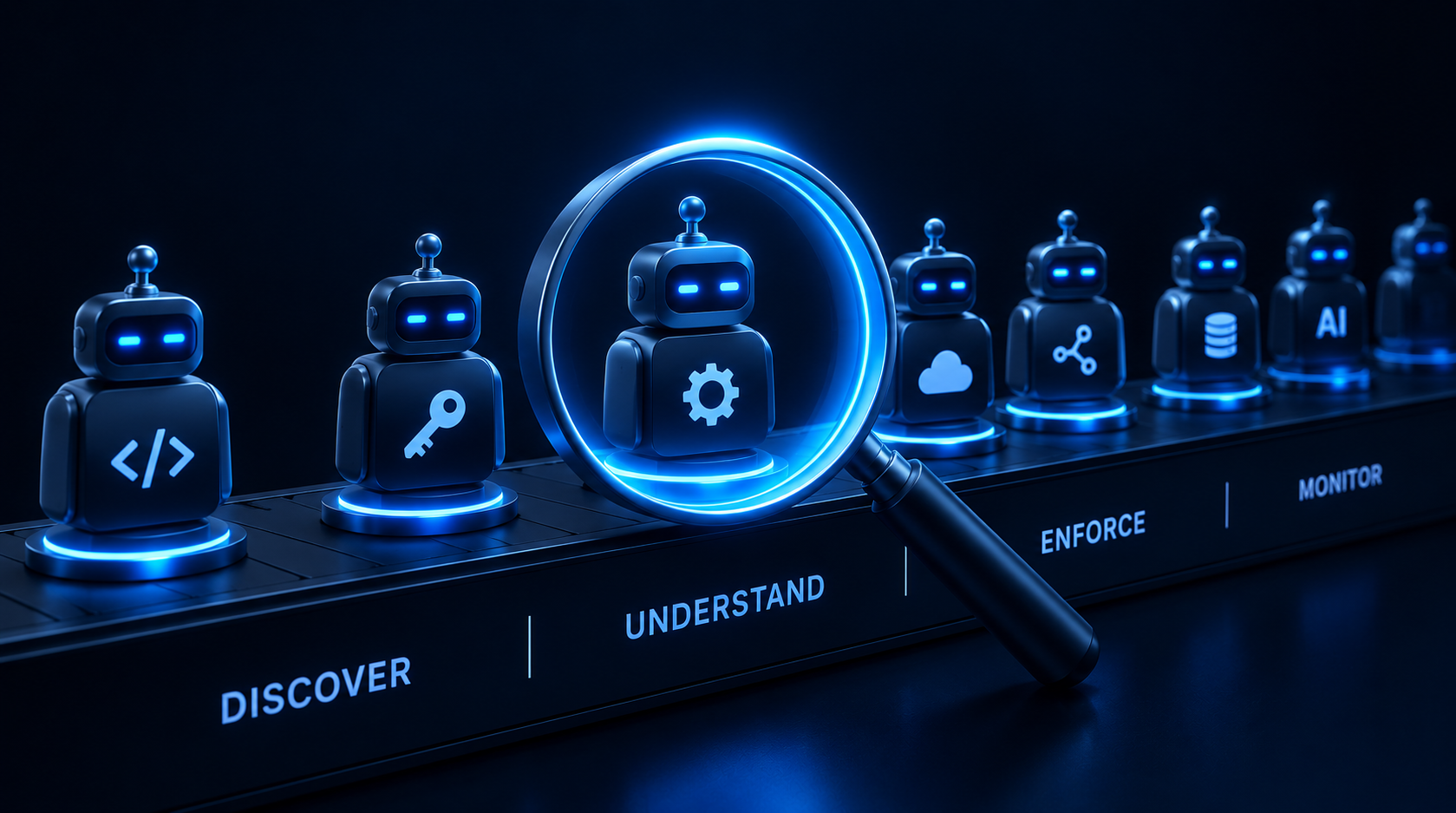
A 4-Step Identity-First Framework for Securing AI Agents
To establish defensible governance over autonomous agents and non-human identities, security leaders should adopt an identity-first operational model:
1. 100% Identity-Driven Discovery
Security teams must achieve complete visibility into all cloud applications and AI services in use across the organization. By monitoring identity-layer telemetry and authentication flows via SaaS identity risk management, organizations can uncover shadow AI deployments instantly—without relying on manual surveys or endpoint agent installations.
2. Non-Human Identity and OAuth Mapping
Every AI agent must be cataloged as a distinct non-human identity. Security teams must map which human user authorized the agent, what OAuth scopes were granted, what third-party services the agent communicates with, and what level of data access it retains.
3. Contextual Risk Assessment and Least Privilege
Evaluate the operational necessity of every autonomous agent. Revoke unused, expired, or overly broad permissions. If an agent only requires read access to a specific project folder, enforce strict scope boundaries rather than permitting broad tenant-wide administrative privileges.
4. Automated Offboarding and Continuous Lifecycle Control
AI agents often persist long after their creators depart the organization or change roles. Automated identity governance must include orphaned agent discovery, ensuring that when an employee leaves the company, all associated non-human identities, API keys, and OAuth grants are systematically identified and decommissioned.
Frequently Asked Questions
What is the difference between Shadow IT and Shadow AI?
While traditional Shadow IT involves employees adopting unauthorized cloud software, Shadow AI involves the adoption of generative models, autonomous agents, and AI copilots that actively ingest enterprise data, make decisions, and execute multi-step actions across connected systems.
Why are AI agents classified as Non-Human Identities (NHIs)?
AI agents act as independent automated entities that hold access tokens, service credentials, or API keys. Because they operate autonomously without requiring a human user to execute every individual action, they must be governed with the same rigor applied to human accounts.
Can traditional single sign-on (SSO) systems govern AI agents?
No. SSO systems only control user login events into sanctioned identity providers. They do not monitor third-party OAuth authorization, machine-to-machine tokens, or autonomous tasks performed inside unsanctioned SaaS applications.
Securing the Autonomous Future
The velocity of enterprise innovation requires security teams to enable business productivity without compromising organizational resilience. Autonomous AI agents present immense opportunities for organizational efficiency, but they cannot remain a shadow IT blind spot. By anchoring AI governance in identity discovery, visibility, and continuous control, enterprise security leaders can confidently embrace the agentic future.
Ready to uncover unmanaged AI agents and non-human identities across your enterprise cloud environment? Discover how a modern SaaS Security Control Plane provides comprehensive discovery and automated identity governance.