May 18, 2026
AI Governance Statistics for 2026: Trends, Risks & Enterprise Data


Explore the most important AI governance statistics for 2026, including AI attack growth, SaaS sprawl, OAuth risk, identity exposure, and governance trends shap

May 18, 2026
Explore the most important AI governance statistics for 2026, including AI attack growth, SaaS sprawl, OAuth risk, identity exposure, and governance trends shap
AI governance has quickly become one of the most discussed priorities in enterprise security. The problem is that most governance programs are operating without visibility into the environments they are supposed to govern.
That disconnect is becoming measurable.
According to Grip Security’s 2026 SaaS + AI Security Report, AI-related attacks increased nearly 490% year over year, while organizations simultaneously expanded their SaaS and AI ecosystems at unprecedented speed.
The result is a governance gap large enough to create operational, regulatory, and security risk at scale.
This report breaks down the most important AI governance statistics, trends, and data points shaping enterprise security in 2026, with a particular focus on identity, OAuth exposure, SaaS sprawl, and visibility gaps.
AI is no longer isolated to standalone chatbots or experimental pilots.
It is now embedded directly into collaboration platforms, CRMs, productivity suites, development tools, marketing systems, and customer support environments.
Most AI governance frameworks were designed around centralized AI initiatives.
Modern enterprise AI adoption is decentralized and distributed across SaaS ecosystems, making traditional governance approaches difficult to enforce consistently.

Enterprise AI growth is not incremental.
It is operationally explosive.
Organizations now manage AI functionality across hundreds of SaaS applications, many of which are adopted outside centralized security review processes.
Governance becomes exponentially harder when AI capability spreads faster than visibility controls.
Security teams cannot govern what they cannot inventory.
AI-related attack activity accelerated dramatically throughout 2025 and into 2026.
Attackers increasingly target:
The attack surface is shifting away from infrastructure and toward identity-driven access paths.
Modern AI governance failures increasingly emerge through integrations and permissions rather than direct system compromise.

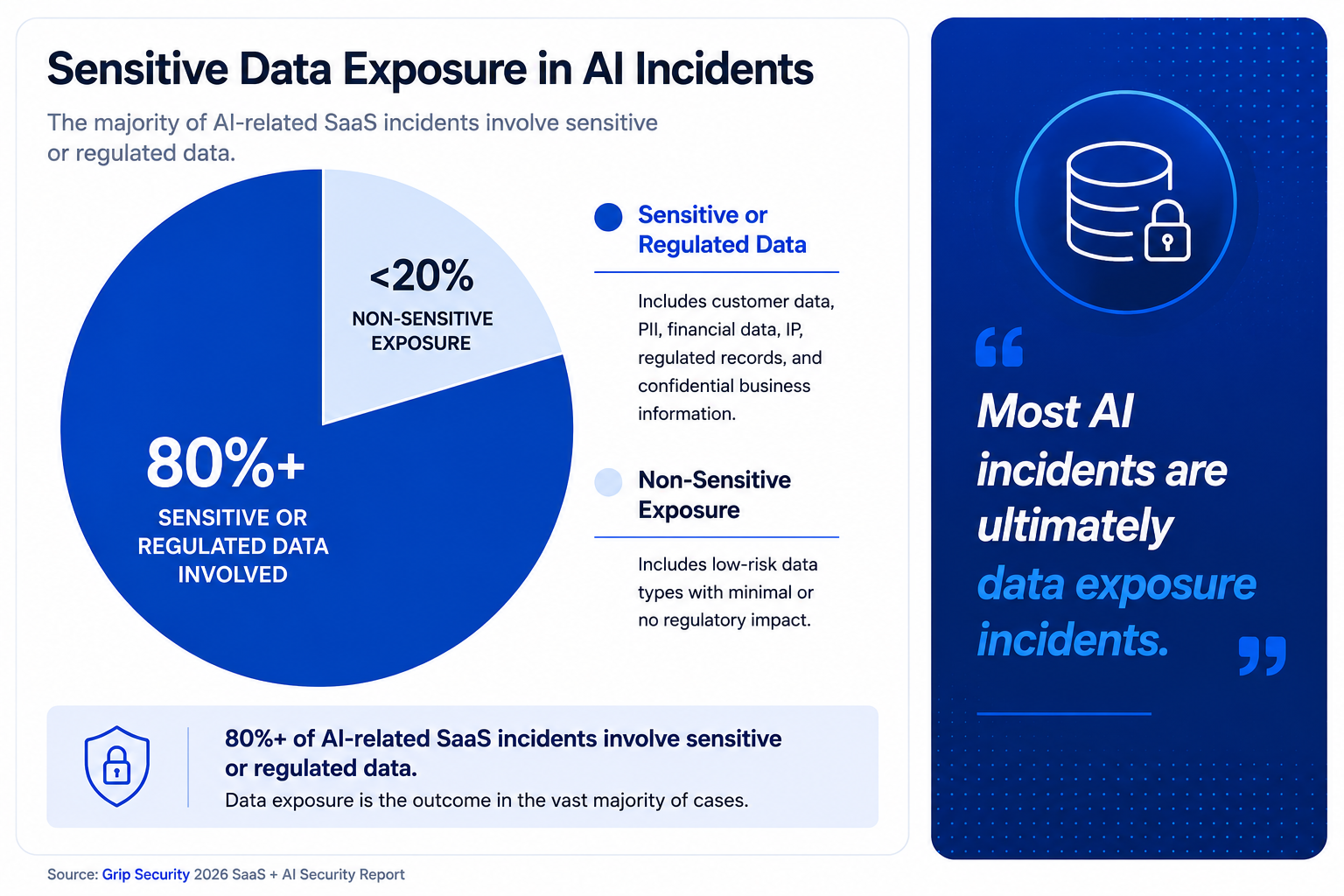
The majority of AI-related incidents are not low-impact operational issues.
They directly involve:
AI governance is no longer just a compliance discussion.
It is a material risk management issue with direct implications for legal exposure, data protection, and operational resilience.
Enterprise SaaS ecosystems continue expanding rapidly.
AI functionality compounds this growth because AI capabilities are increasingly introduced through existing SaaS vendors rather than new standalone platforms.
Governance complexity scales alongside SaaS complexity.
Every SaaS connection introduces additional:
One of the largest governance failures remains simple visibility.
Thousands of SaaS applications operate outside formal review, inventory, or security governance processes.
Shadow SaaS and Shadow AI create governance blind spots where:

OAuth remains one of the least understood governance risks in enterprise AI environments.
Many AI tools request broad delegated permissions to:
OAuth creates indirect trust pathways that traditional governance controls often fail to monitor effectively.
Once granted, delegated permissions can persist long after users forget approvals exist.

Modern AI environments depend heavily on:
These non-human identities increasingly operate with privileged access across enterprise environments.
Governance programs focused exclusively on human users are becoming incomplete.
AI governance now requires visibility into both human and non-human access relationships.

Many enterprises still rely on governance processes built for slower-moving technology environments.
AI adoption does not move at governance speed.
It moves at SaaS speed.
Security teams increasingly face:

The statistics point toward a larger structural shift inside enterprise security.
AI governance challenges are not primarily model governance problems.
They are identity, visibility, and access governance problems.
The modern AI attack surface increasingly consists of:
This changes how governance must operate.
Traditional governance models assumed centralized infrastructure and slower adoption cycles.
Modern AI ecosystems are decentralized, interconnected, and constantly expanding.
The result is that governance increasingly depends on answering a few critical questions:
Organizations unable to answer those questions consistently will struggle to govern AI risk effectively.
Security leaders should treat AI governance as an operational visibility challenge first.
That means prioritizing:
Effective AI governance requires continuous understanding of how access, permissions, integrations, and AI functionality interact across the SaaS ecosystem.
Without that visibility, governance frameworks become policy documents disconnected from operational reality.
To explore these issues further:
Some of the most important AI governance statistics include:
These trends show governance complexity increasing rapidly across enterprise environments.
AI governance is becoming difficult because AI is increasingly embedded inside SaaS applications, integrations, and identity systems that operate outside centralized oversight.
This creates visibility gaps across:
One of the biggest AI governance risks is unmanaged access.
This includes:
These issues create governance blind spots that attackers can exploit.
SaaS sprawl increases the number of applications, integrations, and identities security teams must govern.
As AI becomes embedded into more SaaS platforms, governance complexity grows significantly.
OAuth permissions allow applications and AI tools to access enterprise data and systems without repeated authentication prompts.
If not monitored carefully, these delegated permissions can create long-term governance and security exposure.
The defining AI governance challenge of 2026 is not simply controlling AI models.
It is governing the identity and access relationships that allow AI systems to operate across modern SaaS ecosystems.
That is where the data increasingly points.
And that is where governance strategies are beginning to shift.
AI Governance & Compliance


AI Security & Shadow AI

SaaS Security & SSPM