Jun 10, 2026
ServiceNow Breach: 5 Key Things Security Teams Need to Know


Learn what happened in the reported ServiceNow API exposure, potential security risks, and the SaaS security lessons organizations should take away.

Jun 10, 2026
Learn what happened in the reported ServiceNow API exposure, potential security risks, and the SaaS security lessons organizations should take away.
Security incidents often expose more than a single vulnerability. They reveal gaps in processes, visibility, and configuration management that may have existed long before an attacker discovered them.
The recently disclosed ServiceNow incident appears to be one of those cases. According to public reporting and information shared by administrators, the issue centered on a ServiceNow API endpoint that was accessible without authentication due to a configuration setting. While investigations continue and organizations assess potential impact, there are already several important lessons security teams can take away from the incident.
Here are five key things to know.
According to public reporting, a ServiceNow API endpoint was reportedly configured with authentication disabled, potentially allowing unauthenticated access to certain functionality. Organizations are currently reviewing exposure and investigating whether the endpoint was accessed by unauthorized parties.
While the full scope of impact remains under investigation, the incident has raised broader questions about SaaS configuration management, API security, and continuous posture monitoring.
At the center of the incident was the ServiceNow endpoint: /api/now/related_list_edit/create
According to reports, the endpoint was configured by default with requires_authentication=false, allowing unauthenticated access. As a result, requests could be made to the endpoint without the authentication controls administrators would typically expect for an API handling business data.
Misconfigurations are often difficult to identify because they do not look like traditional vulnerabilities. There may be no software flaw, no exploit chain, and no malicious code involved. Instead, the risk stems from a configuration that creates unintended access.
In SaaS environments, these types of settings can remain unnoticed for extended periods, especially when organizations rely on manual reviews or periodic audits rather than continuous validation.
One of the more notable aspects of the incident is that the issue was reportedly disclosed months before it gained broader attention. According to available information, the vulnerability was first reported in April. However, the report was later closed, leaving the underlying exposure in place.
The details surrounding vulnerability handling and triage remain part of the broader discussion, but the situation highlights an important challenge for both vendors and customers. Security reports are often evaluated based on their perceived impact at the time they are received. In some cases, the true significance of a finding only becomes apparent after additional investigation or active exploitation.
For security leaders, this serves as a reminder that configuration related findings should receive the same level of scrutiny as traditional software vulnerabilities.
As organizations began investigating their environments, some administrators reported seeing requests directed toward the vulnerable endpoint from the IP address: 51.159.98.241
The presence of requests from a particular IP address does not automatically indicate compromise. However, it does provide a useful indicator for security teams reviewing logs and historical activity.
Organizations using ServiceNow should review API logs and access records to determine whether requests associated with this IP address interacted with the affected endpoint. Any unusual activity should be investigated further to understand what data may have been accessed and whether additional actions were performed.
Visibility into API activity is critical during incidents like this because attackers increasingly target application interfaces rather than traditional network entry points.
Organizations concerned about potential exposure should focus on several immediate actions:
Even if no suspicious activity is found, validating configurations and reviewing logs can help establish confidence that the environment was not affected.
While the immediate focus is on the ServiceNow endpoint itself, the broader lesson is about configuration risk across SaaS platforms. Modern organizations operate hundreds of SaaS applications, each containing thousands of security settings, permissions, integrations, and policies. Small configuration changes can create significant exposure when they are not continuously monitored.
This challenge becomes even more difficult when security teams must rely on manual reviews or platform specific administrative knowledge to identify risky settings.
Continuous SaaS Security Posture Management helps address this problem by automatically evaluating configurations against security policies and identifying deviations before they become incidents.
The goal is not simply to detect attacks. It is to reduce the likelihood that attackers find exploitable conditions in the first place.
Grip Security provides SaaS Security Posture Management (SSPM) coverage designed to identify configuration risks across critical SaaS platforms, including ServiceNow.
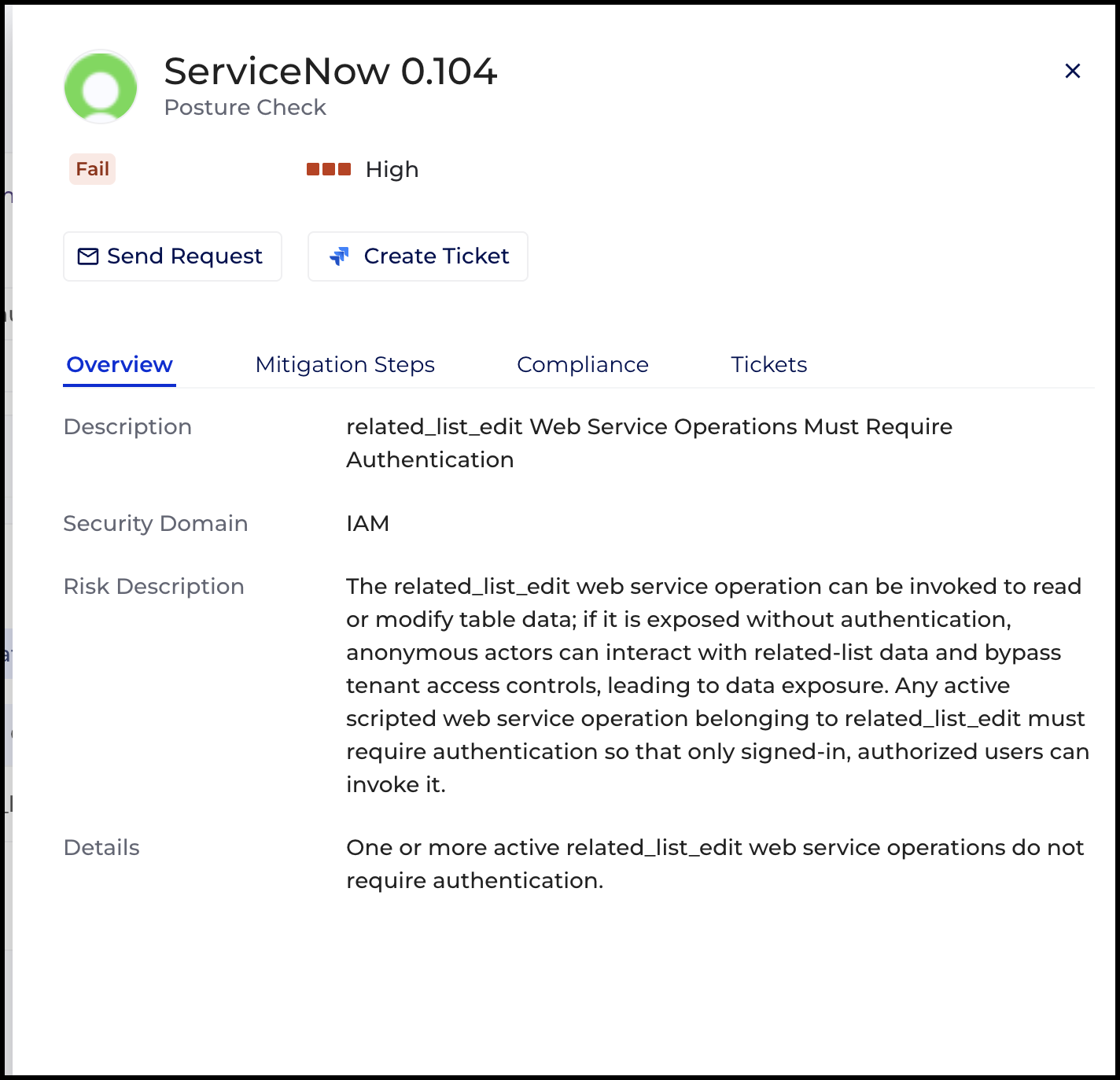
In this case, Grip SSPM policies can detect the specific misconfiguration associated with the vulnerable endpoint by validating that the requires_authentication setting is properly configured. If the setting is not enabled, the policy identifies the issue and helps security teams remediate the exposure.
Grip also helps organizations continuously monitor SaaS environments for risky configurations, security drift, and policy violations that may otherwise go unnoticed.
As organizations investigate this incident, Grip can support validation efforts by helping security teams identify affected configurations, assess exposure, and maintain ongoing visibility into SaaS security posture.
The ServiceNow incident demonstrates how a single configuration setting can create meaningful security exposure.
Although the full scope of the incident continues to be evaluated, organizations do not need to wait for final reports before taking action. Reviewing API activity, investigating requests associated with reported indicators, and validating authentication requirements are practical steps that can be taken immediately.
More broadly, the incident serves as another reminder that SaaS security is increasingly a configuration management challenge. Continuous visibility and posture monitoring remain essential for reducing risk and preventing similar issues from becoming tomorrow's breach.

Fill out the form and watch webinar's video.